

Cloud infrastructure has become more dynamic than ever, making Terraform one of the most valuable tools in modern DevOps. From provisioning AWS resources to managing Kubernetes clusters and automating Azure environments, Terraform enables organizations to define infrastructure as code rather than configuring resources manually. However, with developer-focused alternatives like Pulumi gaining popularity, many engineers are now comparing Terraform vs Pulumi to determine which Infrastructure as Code (IaC) solution best fits their projects.
Although Terraform and Pulumi solve the same fundamental problem—automating cloud infrastructure—they take very different approaches. Terraform uses a declarative language called HashiCorp Configuration Language (HCL), whereas Pulumi allows developers to write infrastructure using familiar programming languages such as Python, TypeScript, Go, Java, and C#.
So, which tool should you choose in 2026?
The answer depends on your team's skills, project requirements, cloud strategy, and long-term DevOps goals. In this guide, we'll compare Terraform and Pulumi in depth, exploring their architecture, programming model, state management, cloud support, scalability, security, and career relevance. Whether you're an aspiring DevOps engineer or looking to strengthen your skills through DevOps training, understanding the strengths of these Infrastructure as Code tools will help you make the right choice.
What is Terraform?
Terraform is an open-source tool that helps you manage your cloud infrastructure using code. HashiCorp created it. Terraform lets you set up, change, and manage your cloud infrastructure without having to do it. Instead of using cloud consoles to create servers and other resources, you define what you want in configuration files. Then Terraform sets up the resources you need.
One of the things about Terraform is that it uses a declarative approach. You just say what you want. Terraform figures out how to make it happen. It compares what you have now to what you want. Then it makes the necessary changes. For example, Terraform can set up:
- AWS EC2 instances
- Azure Virtual Machines
- Google Cloud Compute Engine
- Kubernetes clusters
- Virtual Private Clouds
- Load balancers
- Databases
- AM policies
- DNS records
Terraform is really good at automating cloud infrastructure across providers from a single codebase.
Key Features of Terraform
- Declarative Infrastructure as Code
- HashiCorp Configuration Language
- Support for many clouds
- Planning before deployment
- Reusable modules
- State management
- Big open-source community
- Scalability for big enterprises
Because Terraform is flexible and mature, it has become one of the most sought-after skills in DevOps. Many companies, from start-ups to enterprises, use Terraform.
What is Pulumi?
Pulumi is a platform for managing cloud infrastructure. It lets developers use programming languages to define and manage their infrastructure. Unlike using a special language like Terraform's HCL Pulumi supports languages like Python, TypeScript, and Java. This makes it easy for software developers to apply their programming skills to infrastructure provisioning.
For teams that already use these languages, Pulumi feels like an extension of their workflow. For example, developers can set up:
- AWS infrastructure
- Azure services
- Google Cloud resources
- Kubernetes applications
- Serverless architectures
- Databases
- Networking
- Containers
using the language they use for application development.
Key Features of Pulumi
- Using programming languages for infrastructure
- Strong developer experience
- Object-oriented infrastructure design
- Native Kubernetes support
- Rich IDE integration
- Testing capabilities
- Code reuse through packages and libraries
- Support for clouds
Pulumi has become popular among cloud-native organizations and platform engineering teams. They like how Pulumi follows software engineering principles.
Terraform vs Pulumi: Feature Comparison
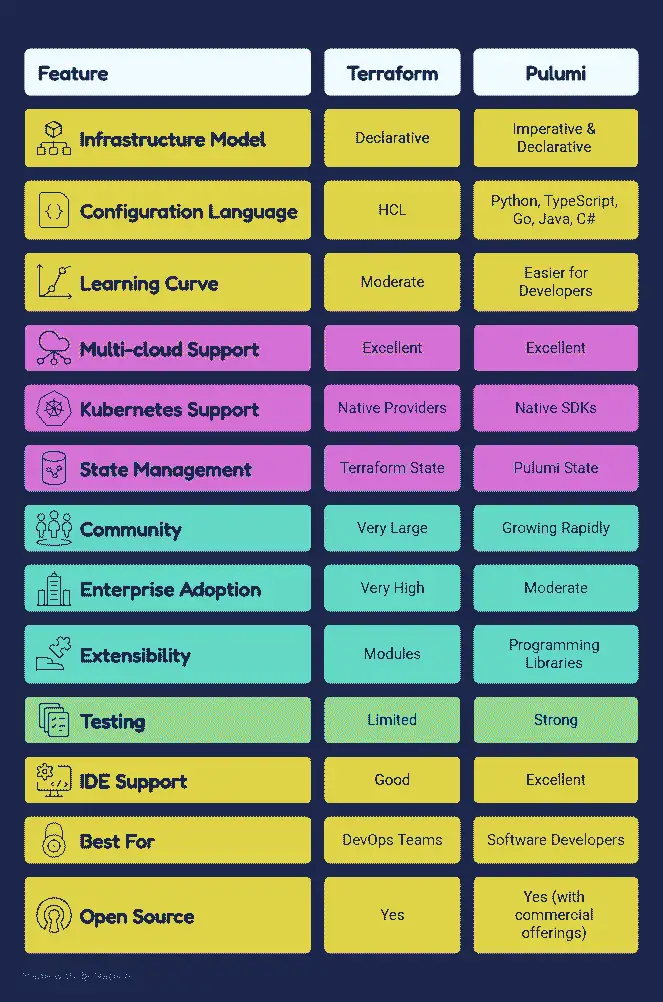
Why Are Engineers Comparing Terraform vs Pulumi?
As more companies move to cloud Infrastructure as Code has become a practice. Terraform has been the leading tool. Pulumi offers a fresh approach by using general-purpose programming languages. This has sparked comparisons between the two tools among teams deciding between declarative infrastructure and developer-centric workflows.
Some key questions include:
- Which tool is easier to learn?
- Which has multi-cloud support?
- Which integrates better with CI/CD pipelines?
- Which scales better for enterprises?
- Which tool provides career opportunities in 2026?
Terraform vs Pulumi: Architecture, Performance, and Real-World Comparison
Now that we've covered the fundamentals of Terraform and Pulumi, it's time to dive deeper into how these Infrastructure as Code (IaC) tools differ in real-world environments. While both automate cloud infrastructure, they follow different philosophies that impact scalability, maintainability, developer productivity, and enterprise adoption.
If you're evaluating Terraform vs Pulumi, the following comparisons will help you choose the right tool based on your organization's needs.
1. Programming Model
One of the biggest differences between Terraform and Pulumi is how infrastructure is defined.
Terraform
Terraform follows a declarative model using HashiCorp Configuration Language (HCL). Instead of specifying how to create infrastructure step by step, you simply describe the desired end state.
For example, you declare that an EC2 instance should exist with specific configurations, and Terraform determines the necessary actions to achieve that state.
Advantages
- Easy to understand
- Predictable execution
- Clean infrastructure definitions
- Simplified collaboration
Best suited for:
- DevOps Engineers
- Infrastructure Teams
- Cloud Architects
Pulumi
Pulumi uses general-purpose programming languages such as Python, TypeScript, Go, Java, and C#.
Developers can use familiar programming constructs including:
- Variables
- Loops
- Functions
- Classes
- Packages
- Conditional statements
This makes infrastructure code highly reusable and dynamic.
Best suited for:
- Software Developers
- Platform Engineers
- Cloud-native application teams
Winner: It depends.
- Terraform wins for infrastructure simplicity.
- Pulumi wins for software engineering flexibility.
2. Learning Curve
The learning experience differs significantly.
Terraform
Terraform requires learning HCL, which is relatively simple because it is designed specifically for Infrastructure as Code.
Most engineers become productive within a few weeks.
Pulumi
Pulumi doesn't require learning a new language if you're already familiar with:
- Python
- TypeScript
- Go
- C#
However, developers without programming experience may find Pulumi more challenging than Terraform.
Winner
- Beginners in DevOps → Terraform
- Experienced Developers → Pulumi
3. Multi-Cloud Support
Modern organizations rarely depend on a single cloud provider.
Both Terraform and Pulumi support:
- AWS
- Microsoft Azure
- Google Cloud Platform
- Kubernetes
- VMware
- Oracle Cloud
- DigitalOcean
- Cloudflare
Terraform
Terraform has one of the largest provider ecosystems available today.
Thousands of providers support cloud services, networking, databases, SaaS platforms, monitoring tools, and Kubernetes.
Pulumi
Pulumi also supports all major cloud providers but uses language SDKs instead of HCL providers.
While its ecosystem continues to grow, Terraform still has broader provider coverage and a more mature ecosystem.
Winner: Terraform
4. State Management
Infrastructure state is one of the most important aspects of any IaC tool.
Terraform
Terraform stores infrastructure information in a state file.
This state file tracks:
- Existing resources
- Dependencies
- Resource IDs
- Configuration mappings
State can be stored:
- Locally
- AWS S3
- Azure Blob Storage
- Google Cloud Storage
- Terraform Cloud
Remote state also enables team collaboration and state locking.
Pulumi
Pulumi also maintains infrastructure.
It supports:
- Pulumi Cloud
- AWS S3
- Azure Blob
- Google Cloud Storage
- Self-managed backends
Both tools offer reliable state management.
Winner: Draw
5. Reusability
Reusable infrastructure saves enormous development effort.
Terraform
Terraform encourages reuse through:
- Modules
- Variables
- Outputs
- Providers
Large organizations often maintain internal Terraform module registries.
Pulumi
Pulumi enables reuse using:
- Functions
- Classes
- Packages
- Libraries
- SDKs
Because it relies on programming languages, abstraction possibilities are nearly unlimited.
Winner: Pulumi
6. Performance
Many engineers ask whether Pulumi is faster than Terraform.
In practice, the answer is not significant.
Provisioning speed primarily depends on:
- Cloud provider APIs
- Number of resources
- Network latency
- Infrastructure complexity
The execution engine contributes only a small part of the total deployment time.
Terraform
- Efficient execution plans
- Dependency graph optimization
- Predictable deployments
Pulumi
- Comparable deployment speed
- Additional runtime overhead from programming language execution
- Better suited for highly dynamic infrastructure generation
For most production workloads, the difference is negligible.
Winner: Slight edge to Terraform
7. Community and Ecosystem
Community support plays a crucial role when solving infrastructure challenges.
Terraform
Terraform has been an industry leader for years and offers:
- Massive open-source community
- Extensive documentation
- Thousands of tutorials
- Mature module registry
- Rich third-party integrations
- Large Stack Overflow presence
Finding solutions is usually straightforward.
Pulumi
Pulumi has a rapidly growing community and excellent official documentation, but its ecosystem is still smaller compared to Terraform.
As adoption increases, community resources continue to expand.
Winner: Terraform
8. Enterprise Adoption
When evaluating Terraform vs Pulumi, enterprise adoption is an important factor.
Terraform is widely used by:
- Fortune 500 companies
- Financial institutions
- Cloud consulting firms
- Government organizations
- SaaS companies
- Healthcare enterprises
Its maturity and vendor-neutral design have made it a standard choice for large-scale infrastructure automation.
Pulumi is increasingly adopted by organizations that emphasize developer productivity and cloud-native engineering, but its enterprise footprint is still growing.
Winner: Terraform
9. Security
Both tools support modern security best practices.
Terraform
Security capabilities include:
- IAM integration
- Policy as Code
- Secret management integrations
- Remote state encryption
- Role-based access control through Terraform Cloud
Pulumi
Pulumi offers:
- Encrypted secrets
- Secret providers
- Policy Packs
- Role-based access
- Secure cloud integrations
Both tools are well-suited for enterprise security requirements when configured correctly.
Winner: Draw
10. Real-World Use Cases
Choose Terraform if you want to:
- Manage large multi-cloud environments
- Build reusable infrastructure modules
- Standardize infrastructure across teams
- Automate Kubernetes deployments
- Implement GitOps workflows
- Work in enterprise DevOps environments
- Prepare for infrastructure-focused DevOps roles
Choose Pulumi if you want to:
- Define infrastructure using Python or TypeScript
- Share application logic and infrastructure code
- Build Internal Developer Platforms (IDPs)
- Leverage software engineering practices
- Create dynamic infrastructure using programming constructs
- Improve developer productivity in cloud-native projects
Which Should You Learn in 2026?
Choosing between Terraform and Pulumi is not about finding the tool. It is about picking the one that fits your career goals, what your team's good at, and the kind of projects you will be doing.
If you are just starting out in DevOps or cloud computing, you should start with Terraform. This is because Terraform is used by a lot of companies. It has a lot of tools that work with it, and companies are looking for people who know how to use it. So it is an idea for people who want to be DevOps engineers to learn Terraform.
On the other hand, Pulumi is a good choice for software developers who want to manage the systems that their code runs on using languages they already know. If your company thinks that developers should be in charge, Pulumi can help you get work done by letting you work on the systems and the code at the same time.
Learning Terraform and Pulumi will give you options, but starting with Terraform will give you a stronger foundation. Terraform and Pulumi are both important, and knowing Terraform and Pulumi will make you better at your job.
Terraform vs Pulumi: Which Tool is Best for Different Use Cases?
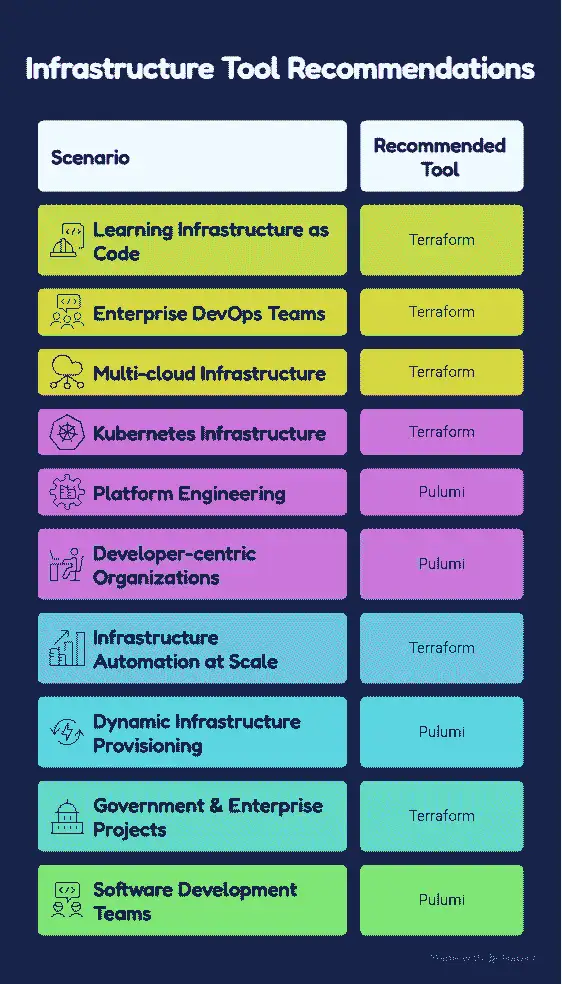
Job Market Demand in 2026
The demand for Infrastructure as Code skills continues to rise as organizations embrace cloud-native technologies and automation. However, Terraform remains significantly more common in job descriptions across industries.
Today, employers frequently look for professionals with experience in:
- Terraform
- AWS
- Azure
- Google Cloud Platform
- Kubernetes
- Docker
- Jenkins
- Github actions
- Linux
- Ansible
Terraform is often listed as a mandatory skill for roles such as:
- DevOps Engineer
- Cloud Engineer
- Site Reliability Engineer (SRE)
- Platform Engineer
- Infrastructure Engineer
- Cloud Architect
Pulumi is increasingly appearing in job postings, particularly for organizations that emphasize cloud-native application development and platform engineering. However, its adoption is still smaller compared to Terraform.
Recommended Learning Roadmap
To build a strong DevOps foundation, follow this progression:
- Linux Fundamentals
- Git and GitHub
- Docker
- Kubernetes
- Terraform
- CI/CD with Jenkins or GitHub Actions
- AWS, Azure, or Google Cloud
- Monitoring with Prometheus and Grafana
- DevSecOps Fundamentals
- Pulumi (Advanced Infrastructure as Code)
This roadmap helps you understand cloud infrastructure before exploring advanced Infrastructure as Code approaches like Pulumi.
Frequently Asked Questions
Is Pulumi better than Terraform?
No. Pulumi is better for developers who like to use programming languages. Terraform is what most people use for Infrastructure as Code.
Can Pulumi replace Terraform?
Yes. Pulumi can replace Terraform. Many organizations still use Terraform because it has a lot of tools and people are used to it.
Is Terraform easier to learn?
Yes. Terraform uses a language called HCL. It is simple and easy for new people to learn.
Does Pulumi support AWS, Azure, and Google Cloud?
Yes. Pulumi supports AWS, Microsoft Azure, Google Cloud Platform, Kubernetes and many other cloud services.
Which tool is better for Kubernetes?
Both tools work well with Kubernetes. Terraform is commonly used to provision Kubernetes infrastructure, while Pulumi is often preferred by development teams that want to manage Kubernetes resources using programming languages.
Should beginners learn Terraform or Pulumi?
If you're new to Infrastructure as Code, Terraform is the better starting point. It provides a strong understanding of declarative infrastructure, which makes learning other IaC tools—including Pulumi—much easier.
Can Terraform and Pulumi be used together?
Yes. Some organizations use Terraform for provisioning core infrastructure while leveraging Pulumi for application-specific or developer-focused infrastructure tasks. The choice depends on project requirements and team preferences.
Final Verdict: Terraform vs Pulumi
When comparing Terraform and Pulumi, both tools offer powerful Infrastructure as Code capabilities. They cater to different audiences. Terraform continues to dominate the IaC landscape in 2026. Its declarative approach, mature provider ecosystem, robust community support, and extensive enterprise adoption make it the preferred choice for DevOps teams.
Pulumi, meanwhile, brings a software engineering mindset to Infrastructure as Code by allowing developers to write infrastructure using languages like Python, TypeScript, Go, and C#. It simplifies infrastructure management for teams that already work extensively with these technologies.
For professionals starting their DevOps journey, the best strategy is to master Terraform once you're comfortable with Infrastructure as Code principles; learning Pulumi becomes significantly easier and broadens your ability to work across different cloud automation environments.
Rather than viewing Terraform and Pulumi as competitors, think of them as complementary tools; understanding when to use each one will make you a more versatile cloud engineer and prepare you for the evolving demands of modern infrastructure management. Infrastructure as Code has become a core skill for DevOps engineers, cloud architects, and platform engineers. Mastering Terraform not only helps automate cloud infrastructure but also improves consistency, scalability, and deployment efficiency across modern cloud environments.
At Paperlive Learning, our DevOps Online Training program is designed to equip you with hands-on experience in Terraform, Docker, Kubernetes, AWS, Jenkins, Git, CI/CD, Linux, and other industry-leading DevOps tools.