

Cloud computing has become the foundation of modern software development, enabling businesses to build, deploy, and scale applications faster than ever before. Whether you're a startup launching your first application or a global enterprise managing thousands of workloads, choosing the right cloud platform can significantly impact your costs, performance, security, and future growth. Among the leading providers, Amazon Web Services (AWS), Microsoft Azure, and Google Cloud Platform (GCP) dominate the market, each offering unique strengths and capabilities.
So, which cloud platform should you choose in 2026?
The right choice depends on your business goals, technical expertise, existing technology stack, and workload requirements. AWS leads the market with its extensive service portfolio and global infrastructure. Azure is the preferred choice for organizations deeply invested in Microsoft's ecosystem, while GCP has earned a strong reputation for data analytics, artificial intelligence, and Kubernetes innovation. Investing in DevOps training can help IT professionals develop the skills needed to effectively deploy, manage, and optimize applications across these leading cloud platforms, enabling organizations to make the most of their cloud investments.
In this comprehensive guide, we'll compare Azure, AWS, and GCP across pricing, performance, security, scalability, AI capabilities, Kubernetes support, and real-world use cases to help you make an informed decision.
What is AWS?
Amazon Web Services (AWS) is the world's largest cloud computing platform, launched by Amazon in 2006. It offers more than 250 fully managed services covering computing, storage, networking, databases, machine learning, analytics, security, serverless computing, and DevOps.
AWS is trusted by millions of organizations, including startups, Fortune 500 companies, and government agencies. Services like Amazon EC2, Amazon S3, Amazon RDS, Lambda, and Elastic Kubernetes Service (EKS) have become industry standards for building cloud-native applications.
One of AWS's biggest strengths is its maturity. It has the largest global infrastructure, extensive documentation, a massive partner ecosystem, and one of the biggest cloud communities worldwide. This makes AWS an excellent choice for organizations requiring high availability, global scalability, and advanced cloud services.
What is Microsoft Azure?
Microsoft Azure is Microsoft's cloud computing platform, designed to help organizations build, deploy, and manage applications across cloud, on-premises, and hybrid environments.
Azure has become particularly popular among enterprises already using Microsoft technologies such as Windows Server, Active Directory, SQL Server, Microsoft 365, and .NET. Its seamless integration with these products makes cloud migration significantly easier for many organizations.
Azure also provides a comprehensive portfolio of services, including Azure Virtual Machines, Azure Kubernetes Service (AKS), Azure SQL Database, Azure Functions, Azure DevOps, AI services, and advanced security solutions. Its strong hybrid cloud capabilities have made Azure a preferred choice for enterprises modernizing existing IT infrastructure.
What is Google Cloud Platform (GCP)?
Google Cloud Platform (GCP) is Google's suite of cloud computing services built on the same infrastructure that powers products like Google Search, Gmail, and YouTube.
Although GCP entered the cloud market later than AWS and Azure, it has become a leader in data analytics, artificial intelligence, machine learning, and Kubernetes. Google originally developed Kubernetes, making GCP one of the best platforms for running containerized workloads through Google Kubernetes Engine (GKE).
GCP is also known for its high-performance networking, global fiber infrastructure, and innovative data services such as BigQuery, Vertex AI, Cloud Run, and Cloud Spanner. Organizations focusing on AI-driven applications and cloud-native development often consider GCP a strong contender.
Azure vs AWS vs GCP: At a Glance
Choosing between AWS, Azure, and GCP often comes down to your organization's priorities. While all three platforms provide computing, storage, networking, databases, AI, and Kubernetes services, they differ in pricing models, enterprise integrations, innovation, and ecosystem maturity.
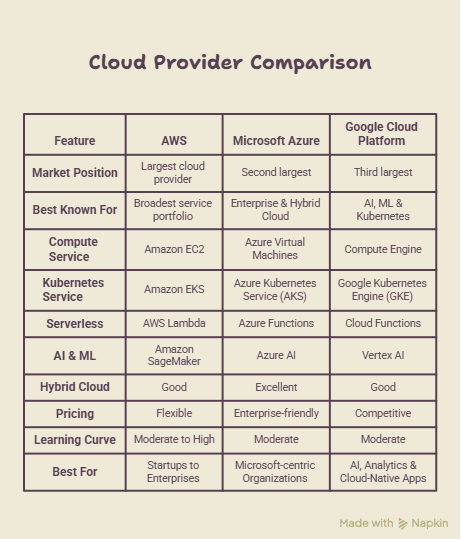
Compute Services
Every cloud platform revolves around compute resources, and each provider approaches them slightly differently. AWS offers Amazon EC2, one of the most mature and feature-rich virtual machine services available. With hundreds of instance types optimized for general-purpose computing, memory-intensive applications, GPUs, and high-performance workloads, AWS provides unmatched flexibility. Organizations can also choose from services like AWS Lambda for serverless computing or ECS and EKS for containerized applications.
Azure provides Azure Virtual Machines, which integrate seamlessly with Windows Server, Active Directory, and Microsoft's broader enterprise ecosystem. Businesses already running Microsoft technologies often find Azure easier to adopt because of its familiar management tools and licensing benefits.
GCP offers Compute Engine, recognized for its excellent performance, custom machine types, and competitive pricing. Google also provides Cloud Run for serverless containers, allowing developers to deploy applications without managing infrastructure. This flexibility makes GCP particularly attractive for modern cloud-native development.
For organizations requiring the widest range of compute options, AWS remains the strongest choice. Enterprises invested in Microsoft technologies typically benefit more from Azure, while startups and cloud-native companies often appreciate GCP's simplicity and efficiency.
Kubernetes and Container Orchestration
Containerization has become the standard for modern application deployment, making Kubernetes support a critical factor when selecting a cloud platform.
AWS provides Amazon Elastic Kubernetes Service (EKS), a fully managed Kubernetes service that simplifies cluster management while integrating with AWS networking, IAM, monitoring, and storage services. EKS is highly scalable but often requires a deeper understanding of Kubernetes administration.
Azure offers Azure Kubernetes Service (AKS), which simplifies Kubernetes deployment by automating cluster upgrades, scaling, and security management. Organizations already using Azure DevOps and Active Directory benefit from seamless integration across Microsoft's ecosystem.
Google Cloud provides Google Kubernetes Engine (GKE), widely regarded as one of the most mature managed Kubernetes services available. Since Google originally created Kubernetes, GKE often introduces new Kubernetes features before other cloud providers. Its automated operations, efficient cluster management, and strong developer experience make it a favorite among DevOps teams.
If Kubernetes is central to your infrastructure strategy, GKE is often considered the benchmark. However, both EKS and AKS continue to evolve rapidly and are excellent choices for enterprise deployments.
Artificial Intelligence and Machine Learning
Artificial intelligence has become one of the biggest differentiators among cloud providers in 2026.
AWS offers Amazon SageMaker, enabling organizations to build, train, and deploy machine learning models at scale. It also provides a wide range of AI services for image recognition, speech processing, language translation, and generative AI applications.
Azure has significantly expanded its AI offerings through Azure AI Services and its deep partnership with OpenAI. Organizations can build intelligent applications using Azure OpenAI Service, Cognitive Services, and machine learning platforms while integrating AI directly into existing Microsoft workflows.
Google Cloud has long been recognized as a leader in artificial intelligence. Services like Vertex AI, Tensor Processing Units (TPUs), BigQuery ML, and Gemini-powered capabilities make GCP particularly attractive for data scientists and organizations building AI-driven applications.
For general AI workloads, all three providers perform exceptionally well. However, organizations focused on advanced analytics and machine learning often view GCP as the innovation leader, while Azure has become increasingly popular because of its enterprise AI ecosystem.
Networking and Global Infrastructure
Cloud performance depends heavily on networking capabilities and global availability.
AWS operates one of the largest global infrastructure networks, with numerous Regions and Availability Zones worldwide. This extensive presence enables organizations to deploy applications closer to users, improving availability and reducing latency.
Azure has also expanded its global footprint significantly and is particularly strong in enterprise networking and hybrid connectivity. Services such as Azure ExpressRoute allow businesses to establish private connections between on-premises data centers and Azure environments.
Google Cloud leverages Google's private global fiber network, which powers services like Google Search, YouTube, and Gmail. This high-performance network provides low-latency connectivity, making GCP an excellent choice for globally distributed applications.
All three providers deliver outstanding global infrastructure, but the best choice often depends on your target regions, compliance requirements, and existing enterprise architecture.
Security and Compliance
Security is one of the most important factors when selecting a cloud platform, especially for organizations handling sensitive customer data or operating in regulated industries. While AWS, Azure, and GCP all follow a shared responsibility model, each provider has its own strengths.
AWS offers one of the most mature security ecosystems in the cloud industry. Services such as AWS Identity and Access Management (IAM), AWS Shield, GuardDuty, Security Hub, Key Management Service (KMS), and AWS Organizations help businesses secure workloads across multiple accounts and regions. Its broad compliance certifications make AWS a trusted choice for industries such as finance, healthcare, and government.
Azure is particularly strong in enterprise security because of its seamless integration with Microsoft Entra ID (formerly Azure Active Directory), Microsoft Defender for Cloud, Microsoft Sentinel, and Purview. Organizations already using Microsoft security products can centrally manage identities, devices, and cloud resources from a unified platform.
Google Cloud Platform focuses on a zero-trust security model. It offers Identity and Access Management, Cloud Armor, Security Command Center, Confidential Computing, and advanced encryption technologies. Google's expertise in securing global-scale infrastructure is reflected in GCP's strong security posture, particularly for cloud-native applications.
Although all three providers meet enterprise security standards, Azure often appeals to organizations invested in Microsoft technologies, AWS remains the preferred option for large-scale enterprise security, and GCP stands out for its innovative security architecture.
Pricing and Cost Optimization
Pricing is often a deciding factor when organizations migrate to the cloud. However, comparing cloud pricing isn't straightforward because each provider uses different pricing models, discounts, and billing structures.
AWS offers on-demand pricing, Reserved Instances, Savings Plans, and Spot Instances, giving organizations flexibility to optimize costs based on workload patterns. While AWS offers the largest selection of services, poor resource management can quickly increase cloud costs.
Azure follows a similar consumption-based pricing model but provides additional savings for organizations with existing Microsoft licenses through the Azure Hybrid Benefit. Enterprises already running Windows Server or SQL Server often achieve significant cost reductions by extending their on-premises licenses to Azure.
Google Cloud is widely recognized for its transparent pricing model. It automatically applies Sustained Use Discounts and Committed Use Discounts without requiring customers to manually reserve capacity. GCP also offers highly competitive pricing for compute-intensive workloads, making it attractive for startups and data-driven organizations.
Regardless of the provider, effective cloud cost optimization depends on monitoring resource utilization, implementing auto-scaling, selecting the right pricing plans, and regularly eliminating unused resources.
Ecosystem and Community Support
A strong ecosystem plays a major role in the long-term success of any cloud platform.
AWS has the largest cloud ecosystem in the world, supported by millions of developers, thousands of certified partners, and an extensive marketplace of third-party solutions. Its vast documentation, learning resources, and active community make it easier for engineers to troubleshoot problems and adopt new services.
Azure benefits from Microsoft's long-standing enterprise relationships and integrates naturally with products such as Microsoft 365, Dynamics 365, GitHub, Visual Studio, and Power Platform. This unified ecosystem enables businesses to build and manage applications more efficiently.
GCP has earned a strong reputation among developers working with Kubernetes, artificial intelligence, and data analytics. While its ecosystem is smaller than AWS's, Google continues to invest heavily in open-source technologies and cloud-native innovation.
If community size and third-party integrations are your priorities, AWS remains the industry leader. Azure is ideal for Microsoft-centric organizations, while GCP appeals to teams focused on modern application development and AI.
Azure vs AWS vs GCP: Which Cloud Platform Should You Choose in 2026?
The best cloud platform depends on your technical requirements, existing infrastructure, and long-term business strategy.
Choose AWS if you:
- Need the broadest range of cloud services.
- Are building highly scalable cloud-native applications.
- Require global infrastructure with extensive regional availability.
- Want access to the largest cloud ecosystem and community.
- Plan to work with advanced DevOps and Kubernetes workloads.
Choose Microsoft Azure if you:
- Already use Windows Server, SQL Server, Microsoft 365, or .NET.
- Need robust hybrid cloud capabilities.
- Require enterprise identity and security management.
- Want seamless integration with Microsoft's business applications.
- Are modernizing existing enterprise infrastructure.
Choose Google Cloud Platform if you:
- Focus on artificial intelligence and machine learning.
- Build Kubernetes-based applications.
- Need powerful data analytics capabilities.
- Prefer competitive pricing for compute-intensive workloads.
- Want to leverage Google's high-performance global network.
There is no single winner because each platform excels in different areas. Many enterprises now adopt a multi-cloud strategy, combining AWS, Azure, and GCP to improve resilience, avoid vendor lock-in, and optimize workloads.
Frequently Asked Questions
Which cloud platform is best in 2026?
There isn't a universal answer. AWS remains the market leader because of its extensive service portfolio and mature ecosystem. Azure is ideal for Microsoft-focused enterprises, while GCP is an excellent choice for AI, analytics, and Kubernetes workloads.
Which cloud platform is easiest to learn?
Azure is often considered easier for professionals already familiar with Microsoft products. AWS has a broader range of services and therefore a steeper learning curve, while GCP offers a clean interface that many developers find intuitive.
Which cloud provider is best for Kubernetes?
All three providers offer managed Kubernetes services, but Google Kubernetes Engine (GKE) is widely regarded as the most mature because Google originally developed Kubernetes. Amazon EKS and Azure Kubernetes Service (AKS) are also excellent options for enterprise deployments.
Which cloud platform offers the best AI services?
AWS, Azure, and GCP all provide advanced AI capabilities. However, GCP is known for its leadership in machine learning through Vertex AI, while Azure has gained significant momentum with its integration of OpenAI services. AWS continues to provide a comprehensive AI portfolio through Amazon SageMaker and other managed AI services.
Should beginners learn AWS, Azure, or GCP first?
For most beginners, AWS is an excellent starting point because it has the largest market share, extensive learning resources, and widespread industry adoption. Once you understand cloud fundamentals, learning Azure or GCP becomes much easier since many core concepts are transferable across platforms.
Conclusion
Choosing between AWS, Azure, and Google Cloud Platform is less about finding the "best" cloud provider and more about selecting the platform that aligns with your business objectives and technical requirements.
If you're looking for the most mature ecosystem, the widest range of services, and strong support for modern cloud-native applications, AWS remains the industry benchmark. Organizations deeply invested in Microsoft technologies will benefit from Azure's seamless enterprise integrations and hybrid cloud capabilities. Meanwhile, businesses focused on artificial intelligence, big data, and Kubernetes-driven architectures will find Google Cloud Platform particularly compelling. Take the next step with an Online DevOps course in Paperlive Learning. Build in-demand skills, learn from experts, and achieve your goals. Enroll today and start your learning journey!