

Containerized applications are really important for software development these days. Companies need platforms to put these applications out there, manage them, and make them work well. That is where Kubernetes and HashiCorp Nomad come in. They are both platforms that help with this, but they do things a bit differently. If you want to make cloud applications, update your computer systems, or get a DevOps certification, you need to know how Kubernetes and HashiCorp Nomad are different.
Kubernetes is the top platform for managing containers, and HashiCorp Nomad is known for being easy to use, not taking up space, and using resources well. The best option for you depends on your setup and how your team knows how much you need to scale. What you want to achieve in the future. If you want to get really good at managing containers and using code for infrastructure, taking a DevOps course can teach you how to work with Kubernetes, Nomad, Docker, Terraform, and other important DevOps tools.
In this guide, we will look at how Kubernetes and HashiCorp Nomad are different in some important areas so you can figure out which one is better for you in 2026.
What Is Kubernetes?
Kubernetes is a platform that helps people work with containers. It was made by Google. Now it is taken care of by the Cloud Native Computing Foundation. Kubernetes makes it easy to put applications on machines and make sure they are working well. It does things like help applications get bigger or smaller. It makes sure they can talk to each other.
Over time, Kubernetes has become very popular. It is the way to run big applications in the cloud. Big companies like AWS, Microsoft Azure, and Google Cloud all offer Kubernetes services that're easy to use. This makes it simple for any company to use Kubernetes.
People like Kubernetes because it has a lot of features. It can automatically update applications, fix problems on its own, and balance the load of work. It can also store information safely. Make sure applications can grow or shrink as needed. Kubernetes works with other tools, which makes it a big part of how people do their jobs.
Kubernetes can be hard to learn. It takes a lot of work to understand how to make it work well. People need to know about the cloud and how to keep things safe. This is why people who are good at Kubernetes are in demand. Kubernetes is also a part of many certification programs.
What Is HashiCorp Nomad?
HashiCorp Nomad is a tool that helps people manage their computer workloads. It can handle containers, virtual machines, and other types of applications from one place. This is different from Kubernetes, which is mostly used for containers. HashiCorp Nomad is easier to use because it can handle different types of workloads and it is not as complicated.
One of the things about Hashi Corp Nomad is that it is easy to get started with. You can set up a HashiCorp Nomad system in just a few minutes. This is because it only needs one program and not a lot of other parts like Kubernetes does. This makes HashiCorp Nomad a good choice for companies with small teams of engineers and organizations that want to keep things simple. HashiCorp Nomad also works well with tools from HashiCorp like Consul and Vault. Consul helps computers find each other on a network, and Vault helps keep information safe. When you use these tools together, you can make a system for managing your computer infrastructure without it being too hard to handle. Though HashiCorp Nomad is not as widely used, it is still becoming popular among organizations that want to manage their infrastructure simply and efficiently.
Kubernetes vs Nomad: Quick Comparison
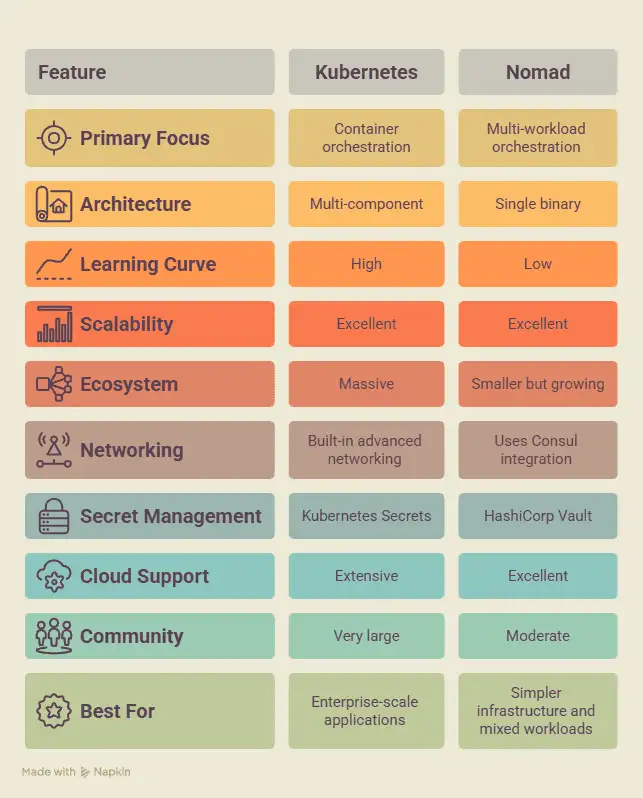
Architecture: Complexity vs Simplicity
The thing that really sets Kubernetes and Nomad apart is how they are built. Kubernetes has a lot of parts that work together, like the API server and the scheduler, the controller manager and the database, etc. The worker nodes have things like kubelet and kube-proxy running on them. This way of building things makes Kubernetes really flexible. It also makes it harder to use.
Nomad is a lot simpler. It just has servers and clients, so there are not many things that can go wrong. Because it is one piece of software, it is easier to install, update, and take care of.
If you have a team of engineers who can handle complicated things, then Kubernetes is a good choice.. If you have a smaller team, Nomad is easier to understand and use. Both are good. They are good for different people. For example, big companies with a lot of engineers can use Kubernetes. Smaller companies, with just a few DevOps people, might like Nomad better because it is simpler.
Deployment and Learning Curve
Learning Kubernetes is tough because you have to know a lot of things like Pods and Deployments and ReplicaSets and StatefulSets and Services and Ingress Controllers and Config Maps and Secrets and Persistent Volumes and Namespaces and Operators. Kubernetes has all these things that help you smartly manage workloads.
Nomad is easier to use because it has a way of doing things. You can start using Nomad with a lot of setup, so it is faster to get started. If your team is just starting out with containers, Nomad is a way to start. If you want to have a career in DevOps, learning Kubernetes is a good idea because so many companies rely on it.
Scalability and Performance
Kubernetes and Nomad are both good at handling a lot of work. Kubernetes has been used by some of the biggest companies in the world. Companies like Spotify, Airbnb, Pinterest, and many Fortune 500 organizations use Kubernetes to manage a number of nodes and containers.
Kubernetes is really good at scheduling and making sure everything runs smoothly. It is also very good at using resources. This makes Kubernetes a great choice for companies with a lot of changing parts.
Nomad is also very good at handling a lot of work without using many resources. Because Nomad is simple and does not need a lot of power to run, it often uses less CPU and memory. This makes Nomad a great choice for companies that want to keep things simple. For companies with complicated workloads, Kubernetes is usually the better choice. For simpler workloads, Nomad is a great option because it works well and is easy to manage.
Networking and Service Discovery
Kubernetes is really good at networking. It has a lot of features that make it easy to use, like service discovery, internal DNS and load balancing, and ingress management. It also supports networking through the Container Network Interface, or CNI for short. Kubernetes users can also use things like Istio or Linkerd to make their networking more powerful. Nomad is a bit different when it comes to networking. It uses HashiCorp Consul to figure out what services are available and to manage the network. This works well if you are already using other HashiCorp tools. It does require a bit more setup compared to Kubernetes, which has all of its networking features built right in.
So if you need to do some complicated networking stuff like setting up special rules for how traffic gets routed or making sure all of your microservices can talk to each other, then Kubernetes is probably a better choice for you. It is better at handling networking situations, and that is why some organizations prefer to use it for their networking needs.
Security and Secrets Management
When you are choosing a platform to manage your containers, you have to think about security.
Kubernetes has a lot of security features like Role-Based Access Control and network policies. It also has admission controllers and standards for securing pods. Kubernetes can manage secrets. It works well with systems that manage identities.
This means companies can meet strict rules they have to follow. Nomad does security a little differently. It works closely with HashiCorp Vault to keep secrets safe. Nomad also supports access controls and special identities for workloads. It even encrypts the information it sends between nodes. Both Kubernetes and Nomad have security features. Kubernetes has a bigger group of security tools and scanners that work with it. This makes it a good choice for companies that have to follow a lot of rules.
Ecosystem and Community Support
The Kubernetes ecosystem is really one of its features. Kubernetes has a lot of projects that work with it, like Helm, Argo CD, Prometheus, Grafana, Flux, Istio, OpenTelemetry, KEDA, and Crossplane.
This means that organizations can use Kubernetes for anything they need to do. Nomad has a group of things that work with it, but it works really well with other Hashi Corp products. If a company is already using Terraform, Vault, and Consul, then Nomad is a fit for them. When you think about which one will have support from the community for a time, Kubernetes is the clear winner because so many people contribute to it and big companies use it.
Cost and Operational Overhead
When we look at these two platforms, we see that they are both sources. However, the cost of running them is very different. To run Kubernetes, you usually need engineers who're very skilled, and you also need other tools to monitor and manage the system and to make sure the network and storage are working properly. You have to do a lot of work to keep the system running, which costs a lot of money, especially if you are managing it yourself. Nomad is simpler. It is easier to manage and does not require as much work. This means that smaller teams can use Nomad without needing a lot of help, which saves money.
When organizations are deciding which platform to use, they should think about all the costs, including how much it costs to pay the people who will be working on it, training them to keep the system running, and the equipment they will need. They should not just think about the cost of the license.
When Should You Choose Kubernetes?
Kubernetes is the ideal choice if your organization:
- Runs large-scale microservices architectures.
- Requires advanced networking and auto-scaling.
- Needs extensive third-party integrations.
- Operates across multiple cloud providers.
- Plans to adopt GitOps, service meshes, and cloud-native technologies.
- Wants access to the industry's largest DevOps ecosystem.
For professionals, learning Kubernetes is also a valuable career investment. It remains one of the most requested skills in cloud computing and DevOps job descriptions worldwide.
When Should You Choose Nomad?
Nomad may be the better option if your organization:
- Prefers operational simplicity.
- Has a small DevOps or infrastructure team.
- Uses the HashiCorp ecosystem extensively.
- Runs mixed workloads beyond containers.
- Wants fast deployment with minimal management overhead.
- Values ease of maintenance over advanced customization.
Nomad enables organizations to focus more on application delivery and less on infrastructure management.
Kubernetes vs Nomad: Which Should You Choose in 2026?
There is no universal winner because both platforms solve different problems.
If you're building complex cloud-native applications, managing hundreds of services, or operating at enterprise scale, Kubernetes remains the most comprehensive and future-proof container orchestration platform. Its unmatched ecosystem, advanced automation capabilities, and widespread industry adoption make it the preferred choice for most large organizations.
On the other hand, if simplicity, faster deployment, and lower operational overhead are your priorities, HashiCorp Nomad offers a compelling alternative. It delivers excellent performance without the complexity of managing a full Kubernetes environment. Ultimately, your decision should align with your team's expertise, infrastructure strategy, and long-term business objectives.
Conclusion
As companies keep using native technologies in 2026, managing containers will still be a big deal for modern DevOps. Nomad is a simple way to do this, but Kubernetes is still the most popular choice because it has a lot of tools and features that big companies need, and a lot of people use it and help each other. For people who want to be DevOps engineers and cloud professionals, learning Kubernetes is an idea for their career. Kubernetes is used by a lot of companies, so knowing how to use it is a skill that everyone who wants to work in cloud computing and DevOps should have.
Whether you are putting applications on your servers in the cloud or on a mix of both, being good at Kubernetes will help you handle the changing needs of managing modern systems.
Ready to master DevOps? Enroll in Paperlive Learning's DevOps Training and gain hands-on experience with Kubernetes, Docker, Terraform, AWS, Jenkins, Git, CI/CD, Linux, and more to build job-ready skills.