


Kubernetes is getting more popular. Companies are using Istio and other service mesh solutions to make it easier for microservices to talk to each other. These days, cloud-native applications are made up of services, sometimes dozens or even hundreds, which makes it really hard to deal with networking, security, and managing traffic within the application code. Istio helps with these problems by providing a service mesh that takes care of how services communicate with each other and handles security and traffic routing, all without needing developers to change their applications.
There are options, though. Linkerd is another choice that's simpler and easier to use and also performs well. Both Istio and Linkerd work well with Kubernetes. Provide the basic things you need from a service mesh, but they are very different in how they are built, how hard they are to use, how well they can scale, and what features they have for big companies. So which service mesh is right for you in 2026? It depends on what your infrastructure's like, what your team is good at, what you need in terms of performance, and what your long-term plan is for cloud-native stuff. In this guide, we will compare Istio and Linkerd in areas to help you figure out which one is the best fit for your Kubernetes setup.
What Is Istio?
Istio is a service mesh that helps make it easier for microservices to talk to each other on Kubernetes. It does this by using something called Envoy proxy sidecars to manage network traffic. This way, the network traffic is separate from the code that the application uses.
One of the things about Istio is that it has a lot of features. Istio supports things like traffic routing, automatic service discovery, and load balancing. Istio also has TLS, authentication, and authorization. Istio has policy enforcement, fault injection, and circuit breaking too. Istio even has distributed tracing and detailed telemetry. All these features of Istio help companies build applications that're secure and reliable. Istio makes it easier for developers to handle the parts of networking.
Istio is really good for companies that have a lot of complex Kubernetes environments. Istio is great for companies that use clusters or cloud providers. The traffic management features of Istio make it perfect for things like canary deployments and green deployments. Istio is also good for A/B testing and progressive delivery strategies.
Even though Istio is very flexible, it can also be hard to use. To install and configure Istio, you need to know a lot about Kubernetes networking and service mesh architecture. You also need to know about certificates. Because of this, companies often train their DevOps teams on Istio before they start using it. Master Istio through hands-on DevOps training and learn to secure, manage, and scale Kubernetes-based microservices with confidence.
What Is Linkerd?
Linkerd is a service mesh that's easy to use, and it works really well. It is designed to be simple and fast. This is different from Istio, which has a lot of features. Linkerd just gives you the things that you need to run your applications on Kubernetes. It is also lightweight and easy to manage. Linkerd works in a way similar to Istio. It puts a proxy next to your application to help it talk to other services. It automatically sets up security. Helps your services find each other. It also helps with things like splitting traffic and trying again if something fails. You can see what is happening in time. You do not need to do a lot of configuration to make it work.
One of the things about Linkerd is that it is easy to get started. You can install it quickly. It does not use up a lot of resources. It is also easy to keep it running. This makes it a good choice for teams or companies that want a service mesh that just works. They do not want to have to deal with a lot of work to keep it running.
Linkerd does not have as many extra tools as Istio. It has everything you need to keep your applications safe and running well. It is a choice if you want something that is easy to use and works well with Kubernetes. You can get performance, and it is not too hard to manage. Linkerd is an option for many companies because it is simple and easy to use.
Istio vs Linkerd: Quick Comparison
Before diving into the details, here's a quick overview of how Istio and Linkerd compare across the most important criteria.
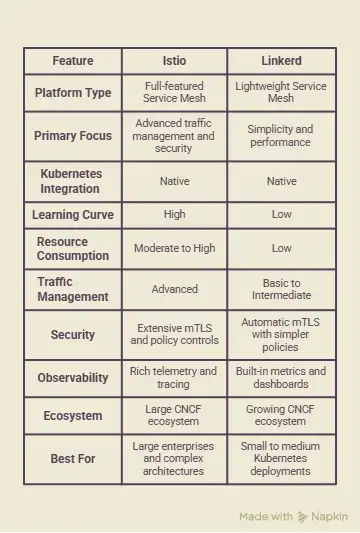
Although both platforms solve the same problem, they target different audiences. Istio focuses on providing complete control over service communication, while Linkerd prioritizes ease of use and operational simplicity.
Architecture and Design Philosophy
The biggest difference between Istio and Linkerd lies in their architectural approach.
Istio is made to be a service mesh that can handle very complicated Kubernetes environments. It uses something called Envoy proxies as sidecars. Has many control plane components that take care of routing, security, and other things. This way of building Istio makes it very powerful but harder to use. Linkerd is made to be much simpler. Its control plane is small on purpose, and its micro-proxy is made with Rust and uses fewer resources than Envoy. This simpler way of building Linkerd makes it faster and easier to update and use.
For companies with complicated networks, Istio is a better choice because it is more flexible.. For teams that want a simple service mesh that just works, Linkerd is often the better option because it is easy to use. Istio and Linkerd are both service meshes but Istio and Linkerd have different ways of doing things. Istio is more complicated. Istio can do more things. Linkerd is simpler. Linkerd is also very good at what it does.
Installation and Ease of Management
When you put a service mesh in place, it should make things easier to handle and not give you work to do.
To get Istio up and running, you usually have to pick some installation options, set up the gateways that let traffic in, turn on the parts that help you see what is going on, get certificate management working, and connect some monitoring tools. Even though it has gotten better over time, the people in charge still need to know a lot about how Kubernetes and service meshes work.
Linkerd is a lot easier to get started with. You only need to run commands to install it, and it has some built-in tools to check that everything is set up right before you start using it.
When you need to upgrade, it is usually not as big of a deal because Linkerd does not take up much space.
For new people, using service meshes with Kubernetes, Linkerd is a lot easier to learn. Istio is harder to use. If you have a lot of experience, it gives you more ways to customize and control things. Linkerd and Istio are both service meshes. They work in different ways. Linkerd is simpler and easier to use, while Istio is more complicated. It gives you more options.
Traffic Management Capabilities
Traffic management is one of the primary reasons organizations deploy a service mesh, and this is where Istio truly stands out.
Istio provides a comprehensive set of traffic management features, including intelligent request routing, traffic shifting, canary deployments, blue-green deployments, fault injection, retries, circuit breaking, rate limiting, request mirroring, and timeout policies. These capabilities make it possible to deploy new application versions gradually while minimizing risk and improving application resilience.Linkerd also supports essential traffic management features such as retries, failover, traffic splitting, and load balancing. However, it intentionally avoids adding unnecessary complexity, making it ideal for organizations that require reliable networking without advanced deployment strategies.
If your Kubernetes platform relies heavily on progressive delivery techniques or sophisticated release management, Istio offers considerably more flexibility.
Security and Zero-Trust Networking
Security has become a top priority for cloud-native applications, especially as organizations adopt zero-trust architectures.
Istio includes one of the most comprehensive security models available in a Kubernetes service mesh. It supports automatic mutual TLS (mTLS), workload identity, fine-grained authorization policies, certificate rotation, authentication rules, and policy enforcement. These capabilities allow administrators to secure communication between microservices with minimal application changes.
Linkerd also enables automatic mutual TLS by default, encrypting service-to-service communication without requiring developers to modify their code. While its security model is simpler than Istio's, it provides strong encryption and authentication for most Kubernetes deployments.
Organizations operating in regulated industries such as finance, healthcare, or government often benefit from Istio's advanced security policies. Smaller teams, meanwhile, may appreciate Linkerd's secure-by-default approach that requires very little configuration.
Performance and Resource Utilization
Performance is another key consideration when selecting a service mesh.
Because Istio offers a broader range of features, its control plane and Envoy sidecars consume more CPU and memory compared to Linkerd. For large Kubernetes clusters, this additional resource usage should be factored into infrastructure planning. Linkerd is widely recognized for its lightweight footprint. Its Rust-based proxy is optimized for speed and low resource consumption, allowing applications to maintain excellent performance while minimizing latency. This efficiency makes Linkerd particularly attractive for organizations running resource-sensitive workloads or smaller Kubernetes clusters. If minimizing operational overhead and maximizing application performance are your primary goals, Linkerd has a clear advantage. However, if your applications require advanced routing, policy enforcement, and enterprise-grade traffic management, Istio's additional resource usage is often a worthwhile trade-off.
Ecosystem and Integrations
One of Istio's biggest strengths is its mature and rapidly evolving ecosystem. As a Cloud Native Computing Foundation (CNCF) project, Istio integrates seamlessly with a wide range of Kubernetes-native tools, making it a preferred choice for enterprises building sophisticated cloud-native platforms.
Istio works exceptionally well with observability tools such as Prometheus, Grafana, Jaeger, and Kiali, providing deep insights into application performance and service-to-service communication. It also supports GitOps workflows through Argo CD and Flux, while integrating with API gateways, security platforms, and policy engines like Open Policy Agent (OPA). These integrations enable organizations to build highly automated and secure Kubernetes environments.
Linkerd also offers strong Kubernetes integrations but follows a more focused philosophy. It integrates with Prometheus, Grafana, Jaeger, and several GitOps tools, providing everything most organizations need for monitoring and deployment automation. However, its ecosystem is intentionally smaller because Linkerd prioritizes simplicity over extensive customization.
If your organization plans to build a highly extensible cloud-native platform with advanced networking capabilities, Istio offers significantly greater flexibility. For teams seeking a straightforward and dependable solution, Linkerd's streamlined ecosystem is often more than sufficient.
Cost and Operational Overhead
Both Istio and Linkerd are open-source projects, meaning there are no licensing fees. However, the real cost lies in operating and maintaining the service mesh.
Istio's rich feature set comes with increased operational complexity. Organizations need engineers who understand Kubernetes networking, certificate management, traffic policies, observability, and service mesh architecture. Managing upgrades, troubleshooting configurations, and monitoring multiple control plane components often requires dedicated platform engineering expertise.
Linkerd keeps operational overhead considerably lower. Its lightweight architecture, smaller control plane, and simplified configuration reduce maintenance efforts and shorten deployment times. Teams can typically manage Linkerd with fewer operational resources, making it an attractive option for startups and mid-sized organizations. When evaluating total cost of ownership, organizations should consider not only infrastructure expenses but also the engineering effort required to deploy, secure, monitor, and maintain the service mesh over time.
Real-World Use Cases
The right service mesh depends largely on the scale and complexity of your Kubernetes environment.
A large enterprise running hundreds of microservices across multiple Kubernetes clusters may choose Istio because of its advanced traffic management, fine-grained security controls, and comprehensive observability. Features such as traffic mirroring, canary deployments, policy enforcement, and multi-cluster support make Istio well suited for organizations with complex operational requirements.
A startup or growing SaaS company, on the other hand, may find Linkerd to be a better fit. Its lightweight architecture, straightforward deployment process, and low resource consumption allow engineering teams to improve application reliability without introducing unnecessary complexity.
Organizations in regulated industries such as banking, healthcare, and telecommunications often favor Istio because of its robust security capabilities and extensive policy management. Meanwhile, companies prioritizing developer productivity and operational simplicity frequently lean toward Linkerd.
Istio vs Linkerd: Which Should You Choose in 2026?
There isn't a one-size-fits-all answer because both service meshes excel in different scenarios.
Choose Istio if your organization:
- Runs large-scale Kubernetes environments.
- Requires advanced traffic routing and deployment strategies.
- Implements zero-trust security architectures.
- Needs detailed observability and policy enforcement.
- Operates across multiple Kubernetes clusters or cloud providers.
- Has experienced Platform Engineering or DevOps teams.
Choose Linkerd if your organization:
- Wants a lightweight and easy-to-manage service mesh.
- Has a small DevOps or Platform Engineering team.
- Prioritizes performance and minimal resource usage.
- Requires core service mesh features without advanced networking complexity.
- Wants to deploy quickly and reduce operational overhead.
For professionals learning cloud-native technologies, Istio offers broader exposure to enterprise-grade service mesh concepts and is more commonly referenced in advanced Kubernetes environments. However, understanding Linkerd is equally valuable because it demonstrates how service meshes can deliver reliability through simplicity.
Frequently Asked Questions
Is Istio better than Linkerd?
It depends on your requirements. Istio is ideal for advanced traffic management, security, and policy enforcement, while Linkerd is better for teams that want a lightweight, simple, and high-performance service mesh.
Does Istio only work with Kubernetes?
No. Istio also supports virtual machines and hybrid environments, but Kubernetes is its primary and most widely used platform.
Why is Istio more complex than Linkerd?
Istio offers advanced features such as traffic routing, security policies, multi-cluster support, and detailed observability, making it more powerful but also more complex to manage.
Is Linkerd faster than Istio?
Generally, yes. Linkerd's lightweight Rust-based proxy typically uses fewer resources and delivers lower latency, though performance varies by workload.
Should beginners learn Istio or Linkerd first?
Beginners should start with Istio because it's widely used in enterprises and provides a strong foundation in service mesh concepts. Learning Linkerd afterward is relatively straightforward.
Conclusion
As Kubernetes continues to power modern cloud-native applications, service meshes have become an essential part of building secure, scalable, and resilient microservices architectures. Both Istio and Linkerd solve the challenge of managing service-to-service communication, but they approach it in different ways.
If your organization needs advanced traffic management, enterprise-grade security, extensive observability, and support for large-scale Kubernetes deployments, Istio remains the leading choice in 2026. Its comprehensive feature set and mature ecosystem make it the preferred service mesh for complex production environments.
If operational simplicity, performance, and ease of management are your priorities, Linkerd provides an excellent alternative. It delivers the core capabilities of a service mesh while keeping resource consumption and administrative effort to a minimum.
Ultimately, the right choice depends on your infrastructure, team expertise, and business goals. For DevOps engineers and cloud professionals, mastering Istio is a valuable investment, as it continues to play a central role in enterprise Kubernetes deployments. Combined with a strong understanding of Kubernetes networking and microservices architecture, Istio expertise can significantly enhance your ability to design, secure, and manage modern cloud-native applications.
Ready to go beyond the comparison? Join Paperlive Learning's DevOps training to gain hands-on experience with Istio, Linkerd, Kubernetes, and other cloud-native technologies. Build practical skills through real-world labs and become confident in deploying and managing production-ready microservices.