

Containerization has transformed how modern applications are developed, deployed, and managed. As organizations adopt containers, understanding Docker vs Kubernetes has become an essential skill for developers, DevOps engineers, and cloud professionals. Docker packages applications and their dependencies into portable containers, while Kubernetes automates the deployment, scaling, networking, and management of those containers. These technologies are core topics in DevOps training, helping professionals build, deploy, and manage cloud-native applications efficiently.
Many beginners mistakenly assume Docker and Kubernetes compete with each other. In reality, they complement one another. Docker creates and packages containers, while Kubernetes manages those containers at scale in production environments.
In this guide, we'll compare Docker and Kubernetes in terms of architecture, scalability, networking, security, performance, use cases, and career opportunities to help you understand when to use each technology and which one you should learn in 2026.
What is Docker?
Docker is an open-source containerization platform that enables developers to package an application, its runtime, libraries, dependencies, and configuration files into a single portable unit called a container.
Unlike virtual machines, Docker containers share the host operating system kernel, making them lightweight, fast, and resource-efficient. This allows applications to run consistently across development, testing, staging, and production environments without compatibility issues.
Docker consists of several key components:
- Docker Engine
- Docker Images
- Docker Containers
- Docker Hub
- Docker Registry
- Docker Compose
For example, a developer can package a Python application into a Docker image and deploy the same container on a laptop, cloud server, or Kubernetes cluster without modifying the application.
Docker significantly simplifies software delivery, making it one of the foundational tools in modern DevOps pipelines.
What is Kubernetes?
Kubernetes (often abbreviated as K8s) is an open-source container orchestration platform originally developed by Google and now maintained by the Cloud Native Computing Foundation (CNCF).
While Docker focuses on creating containers, Kubernetes is responsible for running and managing those containers across multiple servers.
Kubernetes automates tasks such as:
- Container deployment
- Auto-scaling
- Load balancing
- Service discovery
- Self-healing
- Rolling updates
- Rollbacks
- Resource scheduling
- High availability
Instead of manually starting and monitoring containers on individual machines, Kubernetes continuously ensures that applications remain available and healthy, even if servers or containers fail.
This makes Kubernetes the preferred platform for running large-scale microservices and cloud-native applications.
Docker vs Kubernetes: Key Differences
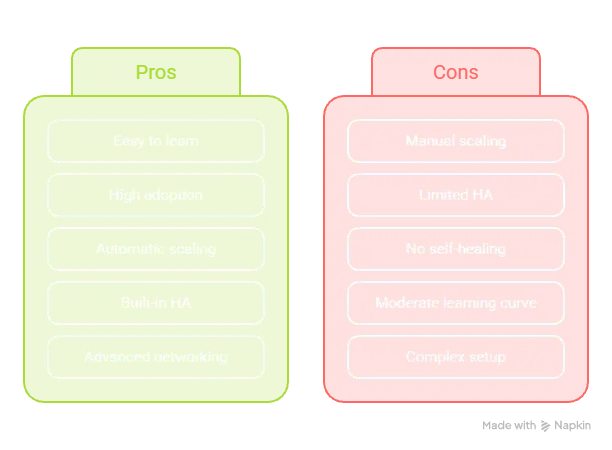
The biggest takeaway is simple: Docker packages applications. Kubernetes manages them.
Docker Architecture
Docker follows a client-server architecture.
The Docker Client communicates with the Docker Daemon, which builds images, starts containers, manages networks, and handles storage. Docker images are stored in repositories such as Docker Hub or private registries.
The workflow is straightforward:
Developer → Dockerfile → Docker Image → Docker Container
This simplicity is one reason Docker has become the industry standard for containerization.
Kubernetes Architecture
Kubernetes has a distributed architecture designed for large-scale production deployments.
A Kubernetes cluster consists of:
- Control Plane
- Worker Nodes
- Pods
- ReplicaSets
- Deployments
- Services
- Ingress Controllers
- etcd Database
Unlike Docker, Kubernetes continuously monitors the desired state of applications. If a container crashes, Kubernetes automatically creates a replacement without manual intervention.
This self-healing capability is one of Kubernetes' defining strengths.
When Should You Use Docker?
Docker is ideal when:
- Developing applications locally
- Creating consistent development environments
- Building CI/CD pipelines
- Packaging applications
- Running lightweight services
- Testing software quickly
- Learning containerization concepts
Small projects often require Docker alone without the complexity of Kubernetes.
When Should You Use Kubernetes?
Kubernetes becomes the better choice when:
- Running production applications
- Managing hundreds of containers
- Building microservices architectures
- Deploying applications across multiple servers
- Requiring automatic scaling
- Ensuring high availability
- Performing rolling updates with zero downtime
Most enterprise cloud applications today rely on Kubernetes for orchestration.
Docker vs Kubernetes: Which Should You Learn First?
If you're starting your DevOps journey, learn Docker first. Docker teaches the fundamentals of containerization, images, containers, networking, and volumes—concepts that are essential before moving on to orchestration. Once you're comfortable with Docker, learning Kubernetes becomes much easier because you'll already understand how containers work. Kubernetes builds on these concepts by introducing pods, deployments, services, scaling, and cluster management.
For aspiring DevOps engineers, the ideal learning path is:
Linux → Git → Docker → CI/CD → Kubernetes → Terraform → Cloud (AWS/Azure/GCP) → Monitoring (Prometheus & Grafana).
Frequently Asked Questions
Is Docker replacing Kubernetes?
No. Docker and Kubernetes are complementary technologies. Docker is used to create containers, while Kubernetes manages those containers in production.
Can Kubernetes work without Docker?
Yes. Kubernetes now supports container runtimes such as containerd and CRI-O. Although Docker is no longer the default runtime, Docker images remain fully compatible with Kubernetes.
Which is easier to learn?
Docker is generally easier because it focuses on containerization. Kubernetes has a steeper learning curve due to concepts like clusters, pods, services, networking, and orchestration.
Which has better career opportunities?
Both skills are highly valuable, but Kubernetes expertise is increasingly sought after for senior DevOps, Platform Engineering, and Cloud Engineering roles. Employers often expect candidates to understand both technologies.
Do I need both Docker and Kubernetes?
Yes. In most modern DevOps environments, Docker is used to build container images, and Kubernetes is used to deploy and manage those images. Learning both provides a strong foundation for working with cloud-native applications.
Conclusion
The debate around Docker vs Kubernetes isn't about choosing one over the other—it's about understanding how they work together. Docker revolutionized application packaging by making software portable and consistent across environments. Kubernetes took containerization a step further by automating deployment, scaling, networking, and lifecycle management for production workloads. If you're just beginning, start with Docker to master the fundamentals of containers. Then move on to Kubernetes to learn orchestration, high availability, and large-scale application management. Together, these technologies form the backbone of modern DevOps and cloud-native development.
As organizations continue to adopt microservices, Kubernetes, and hybrid cloud strategies in 2026, professionals who understand both Docker and Kubernetes will be well positioned for roles such as DevOps Engineer, Cloud Engineer, Site Reliability Engineer (SRE), and Platform Engineer. For anyone aiming to build a successful career in DevOps, learning both tools is no longer optional—it's a competitive advantage.