Continuous Integration and Continuous Delivery (CI/CD) have transformed software development by automating code building, testing, and deployment, enabling organizations to release software faster and more reliably. However, as applications become cloud-native and run across Kubernetes and multi-cloud environments, traditional automation alone is no longer enough.
Modern CI/CD pipelines handle thousands of code commits, tests, security scans, and deployment events every day, yet engineers still spend significant time analyzing failures, reviewing logs, and making deployment decisions. Artificial Intelligence is enhancing CI/CD by adding predictive analytics and intelligent automation. From AI-assisted code reviews and test optimization to deployment validation and proactive monitoring, AI helps teams improve software quality, reduce manual effort, and make faster, data-driven release decisions. These advanced CI/CD and AI-driven automation concepts are increasingly covered in DevOps Training, preparing professionals to build and manage modern software delivery pipelines.
In this guide, you'll learn what an intelligent CI/CD pipeline is, how AI works throughout the software delivery lifecycle, the benefits it offers, the tools enabling intelligent automation, and the best practices for implementing AI-driven CI/CD successfully.
What Is an Intelligent CI/CD Pipeline?
An intelligent CI/CD pipeline is a traditional Continuous Integration and Continuous Delivery pipeline enhanced with Artificial Intelligence to improve software quality, deployment reliability, and operational efficiency. Instead of simply executing predefined workflows, it analyses historical data, deployment patterns, application performance, and infrastructure telemetry to recommend smarter decisions throughout the software delivery lifecycle.
Traditional CI/CD pipelines automate repetitive activities such as compiling source code, running tests, packaging applications, and deploying software into production. These pipelines are deterministic—they follow predefined rules regardless of changing application behaviour or production conditions. While this approach dramatically improves consistency and delivery speed, it cannot independently determine whether a deployment is unusually risky, whether certain tests are unnecessary, or whether an application is likely to fail shortly after release.
An intelligent pipeline introduces AI as a decision-support layer. Machine learning models and generative AI analyze historical pipeline executions, application telemetry, infrastructure metrics, security findings, and deployment outcomes to provide recommendations before engineers make critical deployment decisions.
For example, instead of running every test suite after every code change, AI can determine which tests are most likely to detect regressions based on the files modified and previous failure patterns. During deployment, AI can compare current release characteristics with historical production incidents and alert engineers if a deployment appears unusually risky. After deployment, AI continuously monitors metrics, logs, and traces to detect anomalies long before users experience service degradation.
The result is a CI/CD pipeline that not only automates software delivery but also learns from every release, helping engineering teams improve software quality while reducing operational effort.
Key Characteristics of an Intelligent CI/CD Pipeline
An AI-powered CI/CD pipeline typically includes:
- AI-assisted code reviews
- Intelligent test prioritization
- Predictive deployment validation
- Automated security analysis
- AI-driven anomaly detection
- Intelligent rollback recommendations
- Continuous learning from production telemetry
- AI-assisted root cause analysis
Together, these capabilities transform traditional automation into intelligent software delivery.
Why Should DevOps Teams Use AI in CI/CD?
Modern software delivery has become increasingly complex with cloud-native applications, Kubernetes, Infrastructure as Code, and GitOps. As deployment frequency grows, DevOps teams must analyse large volumes of operational data, making manual investigation inefficient.
Artificial Intelligence addresses this challenge by converting logs, metrics, and deployment data into actionable insights. It helps identify risks, detect anomalies, and recommend actions, enabling faster and more consistent decision-making.
By automating tasks such as build failure analysis, test optimization, deployment validation, and incident investigation, AI reduces operational effort and allows DevOps engineers to focus on improving system reliability and delivery efficiency.
Benefits of Using AI in CI/CD
Organizations adopting intelligent CI/CD pipelines commonly experience:
- Faster software delivery cycles
- Improved deployment confidence
- Better software quality
- Reduced manual troubleshooting
- Faster incident detection
- Lower Mean Time to Recovery (MTTR)
- Intelligent test optimization
- Better developer productivity
- More reliable release management
- Continuous operational improvement
Importantly, AI does not replace DevOps engineers. Instead, it augments their expertise by providing intelligent recommendations while engineers continue making architectural, security, and governance decisions.
How Does AI Work in a CI/CD Pipeline?
Artificial Intelligence can contribute at every stage of the software delivery lifecycle. Instead of functioning as a single tool, AI acts as an intelligence layer that continuously analyses operational data and improves decisions from code commit through production monitoring.
AI in Code Reviews
The pipeline begins when developers commit code to a version control system such as Git. AI-powered code assistants analyse pull requests to summarize changes, identify coding issues, detect security vulnerabilities, recommend improvements, and explain complex implementations before reviewers begin manual inspection. This shortens review cycles while maintaining code quality and consistency across engineering teams.
AI in Build Optimization
Continuous Integration pipelines execute thousands of builds over time. AI studies historical build performance to identify recurring failures, dependency conflicts, inefficient workflows, and opportunities to optimize build execution. Instead of simply reporting that a build failed, intelligent systems explain why it failed and recommend corrective actions, reducing troubleshooting time significantly.
AI in Automated Testing
Testing often consumes the largest portion of pipeline execution time. Running every available test after every code change can slow delivery without providing proportional value.
AI improves testing by:
- Prioritizing high-value test cases
- Detecting flaky tests
- Predicting regression risks
- Recommending additional test coverage
- Optimizing test execution order
This enables faster feedback while maintaining confidence in release quality.
AI in Security Scanning
Security tools frequently generate hundreds of vulnerability reports. AI helps engineering teams prioritize findings by evaluating exploitability, application criticality, infrastructure exposure, and historical security incidents. Rather than treating every vulnerability equally, AI highlights the issues that present the greatest operational risk.
AI in Deployment Validation
Before software reaches production, AI analyses deployment history, infrastructure health, application metrics, and configuration changes to estimate deployment risk.
Instead of asking whether a deployment completed successfully, intelligent systems evaluate whether it is likely to remain stable over time. If anomalies appear likely, the pipeline can recommend staged deployments, additional validation, or temporary approval gates before production rollout.
AI in Production Monitoring
The software delivery lifecycle does not end after deployment. AI continuously monitors metrics, logs, traces, infrastructure telemetry, and user behaviour to detect anomalies before they become outages.
Rather than overwhelming engineers with isolated alerts, AI correlates related events into meaningful incidents, helping teams identify probable root causes much faster.
Common AI Applications Across the CI/CD Pipeline
Some of the most impactful AI use cases include:
- AI-assisted code reviews
- Intelligent build optimization
- Test case prioritization
- Automated deployment validation
- Predictive incident detection
- Intelligent rollback recommendations
- Log and metrics correlation
- Root cause analysis
- Security risk prioritization
- Continuous pipeline optimization
Together, these capabilities transform CI/CD from an automated delivery mechanism into a continuously learning software delivery platform capable of improving with every deployment.
How to Build an Intelligent CI/CD Pipeline with AI
Building an intelligent CI/CD pipeline doesn't require replacing your existing DevOps ecosystem. Instead, it involves adding AI capabilities to every stage of your software delivery workflow, allowing your existing tools to make smarter decisions based on historical data, real-time telemetry, and operational intelligence. Whether your organization uses GitHub Actions, Jenkins, GitLab CI/CD, Azure DevOps, or AWS Code Pipeline, AI can enhance these platforms without disrupting established engineering practices.
The key is to introduce intelligence incrementally. Rather than attempting full automation from day one, organizations should first establish a mature CI/CD pipeline and then integrate AI into areas where it delivers the greatest operational value.
Step 1: Use Git as the Single Source of Truth
Everything should begin with version control. Source code, Infrastructure as Code, Kubernetes manifests, deployment configurations, and CI/CD workflow definitions should all reside in Git repositories. This gives AI access to historical commits, pull requests, deployment records, and configuration changes, allowing it to understand how your software evolves.
Modern AI assistants can summarize pull requests, explain infrastructure modifications, recommend documentation updates, and identify risky code changes before they are merged into production branches.
Step 2: Automate Build and Dependency Analysis
Continuous Integration automatically compiles applications and validates every code change. AI enhances this stage by learning from previous build executions.
Instead of only reporting build failures, AI can:
- Identify recurring build failures
- Detect dependency conflicts
- Recommend caching improvements
- Optimize pipeline execution time
- Suggest package upgrades
- Predict build instability
These recommendations reduce troubleshooting time while improving build reliability.
Step 3: Introduce AI-Assisted Code Reviews
Code reviews remain one of the most important quality gates in software delivery. AI accelerates this process by examining pull requests before human reviewers begin their evaluation.
AI can help by:
- Detecting insecure coding patterns
- Recommending cleaner implementations
- Identifying duplicated logic
- Explaining complex code
- Suggesting performance improvements
- Highlighting architectural inconsistencies
Rather than replacing peer reviews, AI acts as an experienced engineering assistant, allowing reviewers to focus on design decisions instead of routine issues.
Step 4: Optimize Testing with Machine Learning
Testing is often the longest stage of a CI/CD pipeline. Running every available test after every commit wastes compute resources and slows software delivery.
Machine learning models improve testing by:
- Prioritizing high-impact test cases
- Predicting regression risks
- Identifying flaky tests
- Recommending missing test coverage
- Reducing redundant test execution
- Improving pipeline efficiency
This enables faster feedback while maintaining confidence in software quality.
Step 5: Validate Deployments Before Production
Traditional deployment pipelines determine whether a deployment completed successfully. Intelligent pipelines evaluate whether that deployment is likely to remain healthy after release.
AI analyzes:
- Historical deployment outcomes
- Infrastructure health
- Resource utilization
- Application telemetry
- Configuration changes
- Security findings
- Previous rollback events
Based on this information, AI can recommend staged deployments, canary releases, or additional validation before software reaches production.
Step 6: Continuously Learn from Production
An intelligent pipeline continues learning long after deployment.
Production environments generate enormous amounts of operational data, including:
- Logs
- Metrics
- Distributed traces
- User experience data
- Infrastructure telemetry
- Application performance metrics
- Incident reports
AI analyses this information to detect anomalies, recommend root causes, identify recurring problems, and continuously improve future deployments.
The result is a software delivery process that becomes smarter with every release.
What AI Tools Can Be Used in CI/CD Pipelines?
Artificial Intelligence is rapidly becoming a native capability within modern DevOps platforms. Rather than purchasing standalone AI products, organizations increasingly integrate AI into the tools they already use for software development, deployment, monitoring, and security.
Below are some of the most widely adopted AI-enabled DevOps tools.
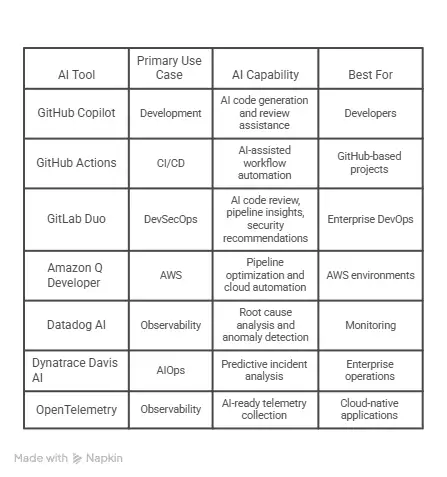
When selecting AI tools, prioritize integration over individual features. A well-connected ecosystem where source control, CI/CD, monitoring, cloud infrastructure, and observability platforms exchange data will produce significantly better AI recommendations than isolated tools operating independently.
What Are the Benefits of AI-Powered CI/CD Pipelines?
Organizations adopting intelligent CI/CD pipelines often experience measurable improvements in software delivery, operational efficiency, and engineering productivity. While traditional automation focuses on executing predefined workflows, AI continuously analyzes data to optimize those workflows over time.
Faster Software Delivery
AI reduces pipeline execution time by prioritizing relevant tests, optimizing builds, and eliminating unnecessary manual analysis. Developers receive feedback more quickly, enabling shorter release cycles and faster feature delivery.
Better Deployment Quality
AI evaluates deployment risk before software reaches production. By comparing current deployments with historical release data, intelligent systems help engineering teams identify potential issues before customers are affected.
Reduced Operational Toil
DevOps engineers spend significant time investigating failed builds, deployment regressions, unstable tests, and infrastructure alerts.
AI automates repetitive analysis by:
- Correlating logs
- Explaining failures
- Identifying recurring issues
- Suggesting remediation steps
- Prioritizing incidents
This allows engineers to focus on architecture, innovation, and platform engineering.
Improved Software Reliability
AI-powered monitoring identifies anomalies long before they escalate into customer-facing outages. Instead of reacting to failures, organizations begin preventing them through predictive analytics.
Enhanced Security
Security scanning becomes more intelligent when AI adds context to vulnerability reports.AI helps by:
- Prioritizing critical vulnerabilities
- Detecting exposed secrets
- Identifying risky dependencies
- Monitoring configuration drift
- Recognizing unusual runtime behaviour
This improves DevSecOps without overwhelming security teams with false positives.
Increased Developer Productivity
AI reduces repetitive engineering work throughout the software development lifecycle. Developers spend less time:
- Reviewing logs
- Writing documentation
- Investigating build failures
- Analyzing deployments
- Creating release notes
Instead, they spend more time designing resilient systems and delivering business value.
What Challenges Should Organizations Consider?
Although AI significantly improves CI/CD pipelines, successful adoption requires thoughtful governance and realistic expectations. AI should enhance engineering judgment—not replace it.
One of the biggest challenges is trust. Large Language Models occasionally generate inaccurate code, incorrect YAML configurations, or misleading deployment recommendations. Without proper validation, these suggestions can introduce production risks.
Organizations should therefore implement multiple validation layers before accepting AI-generated changes.
Common Challenges Include
- AI hallucinations
- Incorrect Infrastructure as Code generation
- Poor-quality operational data
- Security risks
- Prompt injection attacks
- Compliance concerns
- Limited explainability
- Excessive reliance on automation
Human oversight remains essential, particularly for production approvals, infrastructure modifications, and security-sensitive deployments.
Another important consideration is observability. AI recommendations are only as good as the data available. Organizations with incomplete logging, inconsistent metrics, or poor monitoring will receive lower-quality insights than teams with mature observability practices.
Ultimately, AI should be viewed as an engineering co-pilot rather than an autonomous deployment engine. The strongest DevOps organizations combine intelligent automation with experienced engineers, robust governance, and continuous operational feedback to build secure, reliable, and scalable software delivery pipelines.
Best Practices for Building AI-Driven CI/CD Pipelines
Building an intelligent CI/CD pipeline is not about introducing AI into every stage overnight. Successful organizations first establish reliable DevOps practices and then gradually integrate AI where it provides measurable value. AI works best when it complements engineering expertise, not when it replaces proven operational processes.
A strong foundation begins with automation. Source code, Infrastructure as Code, Kubernetes manifests, and deployment configurations should all be version-controlled, while builds, testing, and deployments should already be automated. AI becomes significantly more effective when it operates within structured and repeatable workflows.
To maximize the value of AI-powered CI/CD, consider the following best practices:
- Build a mature CI/CD pipeline before introducing AI.
- Keep Git as the single source of truth for application and infrastructure changes.
- Implement comprehensive observability using logs, metrics, traces, and deployment events.
- Validate AI-generated recommendations through automated testing and human review.
- Use Policy as Code to enforce governance and compliance.
- Protect secrets and credentials throughout the software delivery lifecycle.
- Monitor DORA metrics such as Deployment Frequency, Lead Time, Change Failure Rate, and Mean Time to Recovery (MTTR).
- Continuously improve AI models using production telemetry and deployment feedback.
- Maintain human approval for high-risk production deployments.
- Review AI performance regularly to ensure recommendations remain accurate and aligned with business goals.
Organizations that treat AI as a collaborative engineering assistant rather than a replacement for DevOps expertise are more likely to achieve sustainable improvements in delivery speed, software quality, and operational resilience.
Conclusion
Artificial Intelligence is redefining what modern software delivery looks like. Traditional CI/CD pipelines brought speed and consistency to application deployment, but AI is taking software delivery one step further by introducing predictive intelligence, contextual decision-making, and continuous optimization.
From AI-assisted code reviews and intelligent testing to deployment validation, anomaly detection, and predictive monitoring, intelligent CI/CD pipelines reduce operational complexity while improving software quality and release confidence. Organizations can deploy applications more frequently, recover from incidents faster, and spend less time performing repetitive operational work.
However, AI should not be viewed as a replacement for DevOps principles. Strong automation, observability, security, governance, and engineering expertise remain the foundation of every successful CI/CD implementation. AI simply amplifies these capabilities by transforming operational data into actionable insights.
As cloud-native architectures, Kubernetes, and multi-cloud environments continue to evolve, intelligent CI/CD pipelines will become a competitive advantage for organizations seeking faster innovation without compromising reliability. DevOps engineers who embrace AI today will be better prepared to build the resilient, automated, and intelligent software delivery platforms of tomorrow.
Frequently Asked Questions
What is an intelligent CI/CD pipeline?
An intelligent CI/CD pipeline combines traditional automation with Artificial Intelligence to improve software delivery. It uses AI to analyze code changes, optimize testing, validate deployments, detect anomalies, and continuously learn from operational data.
Which AI tools are commonly used in CI/CD pipelines?
Popular AI-enabled tools include GitHub Copilot, GitHub Actions, GitLab Duo, Amazon Q Developer, Azure DevOps with AI capabilities, Datadog AI, Dynatrace Davis AI, and OpenTelemetry-powered observability platforms.
Can AI automate software deployments completely?
AI can automate many deployment-related tasks such as risk analysis, deployment validation, rollback recommendations, and monitoring. However, production approvals and critical architectural decisions should continue to involve experienced engineers.
Is learning AI important for DevOps engineers?
Yes. AI is becoming an essential part of modern DevOps workflows. Engineers who understand AI-assisted automation, cloud-native technologies, observability, and intelligent software delivery will be well positioned for future DevOps, Platform Engineering, and SRE roles.
Build real-world GitHub CI/CD skills with PaperLive Learning's hands-on DevOps training.