

Containerized applications have changed the way we make software. This is why Kubernetes is what most people use to manage containers. When companies start using cloud technology, they also think about using Red Hat OpenShift because it has features that big companies need. Although Kubernetes and Red Hat OpenShift are similar, they serve different purposes. Kubernetes is good because you can use it anywhere, and it works with a lot of things. On the other hand, OpenShift makes it even better by adding security and tools that help developers. It also comes with support from Red Hat, which's a big help for companies.
So, which platform should you choose in 2026?
The answer depends on your organization's size, infrastructure strategy, operational expertise, and business objectives. In this guide, we'll compare Kubernetes and OpenShift across architecture, deployment, security, scalability, cost, ecosystem, and real-world use cases to help you make an informed decision.
What is Kubernetes?
Kubernetes is an open-source container orchestration platform originally developed by Google and now maintained by the Cloud Native Computing Foundation (CNCF). It automates the deployment, scaling, networking, and lifecycle management of containerized applications across clusters of physical or virtual machines.
Instead of manually managing hundreds of containers, Kubernetes continuously monitors application health and ensures workloads remain available. If a container crashes, it can automatically restart. If demand increases, it can scale applications horizontally by launching additional container replicas. These capabilities have made Kubernetes the preferred orchestration platform for organizations building cloud-native applications.
One of Kubernetes' biggest strengths is its flexibility. It supports deployments across public clouds, private data centers, hybrid environments, and edge infrastructure. Whether you're using AWS, Microsoft Azure, Google Cloud, or an on-premises Kubernetes cluster, the platform provides a consistent way to deploy and manage workloads.
Beyond orchestration, it offers features such as service discovery, load balancing, rolling updates, self-healing, persistent storage management, secret management, and autoscaling. Its rich ecosystem includes thousands of open-source tools like Helm, Prometheus, Grafana, Argo CD, Istio, and KEDA, allowing organizations to build highly automated DevOps workflows.
Because of its widespread adoption, Kubernetes has become one of the most valuable skills for DevOps and cloud professionals. It is now a core component of most DevOps certification programs and is frequently listed as a required skill in cloud engineering job descriptions.
What Is OpenShift?
OpenShift is Red Hat's enterprise Kubernetes platform that extends the capabilities with additional tools, automation, and security features. While Kubernetes provides the foundation for container orchestration, OpenShift packages it into a complete application platform that simplifies deployment, operations, and lifecycle management.
At its core, OpenShift runs Kubernetes, but it enhances the experience with features designed for enterprise environments. It includes an integrated container registry, built-in CI/CD capabilities, developer-friendly dashboards, monitoring tools, logging, networking, and automated cluster installation. This reduces the amount of manual configuration typically required when setting up a production-ready Kubernetes environment.
One of OpenShift's defining strengths is its focus on security. By default, it enforces stricter security policies, runs containers as non-root users, and includes advanced access controls that help organizations meet compliance requirements. These built-in safeguards make OpenShift particularly attractive to industries such as banking, healthcare, telecommunications, and government, where security and regulatory compliance are top priorities.
Another key advantage is commercial support. Unlike community Kubernetes distributions, OpenShift is backed by Red Hat, giving enterprises access to long-term support, certified updates, and expert technical assistance. For organizations that prefer vendor-backed platforms with predictable maintenance cycles, this can significantly reduce operational risk.
Although OpenShift requires licensing, many enterprises consider the investment worthwhile because it lowers operational complexity, accelerates application delivery, and provides a more integrated developer experience compared to managing Kubernetes from scratch. Join Paperlive Learning's DevOps Training and gain hands-on experience with OpenShift, Kubernetes, CI/CD, and enterprise container platforms.
Kubernetes vs OpenShift: Side-by-Side Comparison
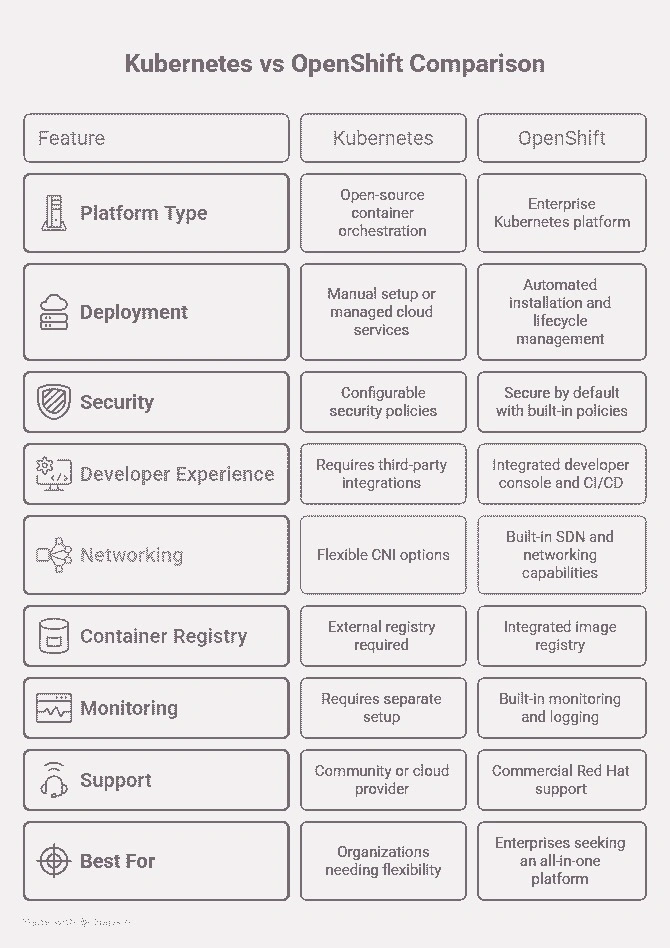
Although OpenShift is built on Kubernetes, the two platforms offer different experiences when it comes to deployment, management, security, and enterprise readiness. Kubernetes provides a highly flexible foundation that organizations can customize to their exact requirements. OpenShift, on the other hand, packages it with enterprise-grade tools, automation, and support, making it a more complete platform out of the box. While both platforms can run production workloads efficiently, the choice depends on how much control you want versus how much operational complexity you're willing to manage.
Deployment and Cluster Management
One of the biggest differences between Kubernetes and OpenShift lies in how they are deployed and managed.
With Kubernetes, organizations typically start by provisioning infrastructure, installing the Kubernetes control plane, configuring worker nodes, setting up networking, implementing storage, integrating monitoring, and configuring security policies. While managed Kubernetes services such as Amazon EKS, Azure AKS, and Google Kubernetes Engine simplify some of these tasks, teams are still responsible for configuring many production-ready components.
OpenShift significantly reduces this operational burden. It includes automated installation, built-in upgrades, cluster lifecycle management, and integrated infrastructure services. Administrators can provision clusters more quickly without assembling multiple third-party tools.
For organizations with experienced platform engineering teams, it provides greater flexibility and customization. However, businesses looking to accelerate deployment while minimizing operational overhead often find OpenShift to be a more efficient choice.
Security and Compliance
Security is one of the strongest reasons enterprises choose OpenShift over standard Kubernetes.
Kubernetes offers powerful security capabilities, including Role-Based Access Control (RBAC), Network Policies, Secrets, Pod Security Admission, and integration with external identity providers. However, many of these features require careful configuration and ongoing management to meet enterprise security standards.
OpenShift takes a more opinionated approach by enforcing secure defaults. Containers run as non-root users by default, Security Context Constraints (SCCs) provide stricter workload isolation, and built-in image scanning helps organizations identify vulnerabilities before deployment. These features reduce the risk of common misconfigurations while helping organizations meet compliance frameworks such as PCI DSS, HIPAA, and SOC 2.
For industries where regulatory compliance is non-negotiable, OpenShift offers a stronger security posture with less manual effort.
Developer Experience and Productivity
Another major area of differentiation, developer productivity, is a big element of modern software delivery. Kubernetes offers a very strong and extensible API driven platform, but to unlock the full potential and achieve CI/CD capabilities, developers would traditionally need to weave together other tools like Helm, ArgoCD, Jenkins, GitHub Actions, and Tekton. Whilst this approach offers an organisation significant flexibility in the way they want to architect their CI/CD pipeline, it comes with additional configuration and maintenance efforts.
OpenShift provides these capabilities integrated directly into the platform, simplifying the development and delivery cycle through a web console, S2I (Source-to-image) builds integrated into the pipeline, Tekton-based pipeline tools, image streams, and deployment automation for a faster trip to production.
For teams looking for an all-in-one approach to accelerate their path to market, they might consider OpenShift, and those that wish to pick their preferred best-of-breed tool stack will likely opt for Kubernetes.
Ecosystem and Extensibility
Kubernetes has the largest open-source ecosystem worldwide. In fact, the ecosystem supporting is responsible for hundreds of thousands of apps, spanning across app packaging (Helm), monitoring (Prometheus and Grafana), service mesh (Istio), GitOps (Argo CD), KEDA (event-driven auto scaling), infrastructure automation (Crossplane), and hundreds more. An open source Kubernetes cluster can be customized to support a cloud-native environment built by your company. While it is also true that OpenShift includes support for many of these open source projects because it uses Kubernetes as its base product, it also includes its own enterprise set of tools natively.
Customers are not assembling together 20-odd different open source products; they get a vetted, red-teamed platform.
The bottom line: If innovation and flexibility are your highest priority, then the Kubernetes ecosystem is for you. If consistency, stability, and integration support with a variety of commercial vendors, you want a smoother, easier path like the one provided by OpenShift.
Scalability and Performance
Both Kubernetes and OpenShift are designed to support highly scalable workloads and distributed applications.
Kubernetes has been proven at massive scale by some of the world's largest technology companies, running thousands of nodes and millions of containers. Its advanced scheduling engine, horizontal pod autoscaling, cluster autoscaling, and self-healing capabilities make it well suited for demanding cloud-native environments.
Since OpenShift is built on Kubernetes, it inherits these same scalability features while adding enterprise management capabilities. Performance differences between the two platforms are generally minimal, although OpenShift's additional services may introduce slight overhead in exchange for easier operations and enhanced functionality.
For most organizations, scalability is unlikely to be the deciding factor because both platforms can comfortably support modern enterprise applications.
Cost and Operational Overhead
When evaluating container platforms, licensing costs are only one part of the equation. Organizations should also consider infrastructure expenses, maintenance efforts, training requirements, and the engineering time needed to manage the platform.
Since Kubernetes is open source, there are no licensing fees. However, deploying and maintaining a production-grade Kubernetes environment often requires experienced DevOps engineers. Teams must configure networking, ingress controllers, storage, monitoring, logging, security policies, backup strategies, and cluster upgrades. These operational responsibilities can increase the total cost of ownership, especially for organizations managing multiple clusters.
OpenShift, on the other hand, is a commercial platform that requires a Red Hat subscription. While the licensing cost is higher, much of the operational complexity is reduced through built-in automation, integrated monitoring, centralized management, and enterprise support. Many organizations find that these features lower administrative overhead and reduce the time spent troubleshooting infrastructure issues.
For startups and small engineering teams with limited budgets, Kubernetes is often the more economical choice. Large enterprises, however, may see greater long-term value in OpenShift because it minimizes operational risks and simplifies day-to-day management.
Real-World Use Cases
Choosing between Kubernetes and OpenShift becomes easier when viewed through real-world scenarios.
A fast-growing SaaS startup building cloud-native applications may prefer Kubernetes because it offers maximum flexibility, integrates with virtually every cloud provider, and allows engineers to customize every aspect of the platform. With skilled DevOps engineers on the team, Kubernetes provides complete control over infrastructure and application deployment.
In contrast, a financial institution handling sensitive customer data may choose OpenShift because of its built-in security controls, compliance-friendly architecture, and commercial support. These organizations often prioritize stability, governance, and vendor-backed reliability over extensive customization.
Similarly, healthcare providers, government agencies, and large manufacturing enterprises frequently adopt OpenShift to accelerate digital transformation while maintaining strict regulatory compliance.
The choice ultimately depends on whether your organization values flexibility or operational simplicity more.
Kubernetes vs OpenShift: Which Should You Choose in 2026?
There is no universal winner because both platforms are designed for different operational priorities.
Choose Kubernetes if your organization:
- Wants maximum flexibility and customization.
- Has experience with DevOps or Platform Engineering teams.
- Builds cloud-native microservices at scale.
- Uses multiple cloud providers or hybrid infrastructure.
- Prefers open-source technologies with a vast ecosystem.
- Plans to integrate specialized tools for CI/CD, monitoring, and GitOps.
Choose OpenShift if your organization:
- Requires enterprise-grade security from day one.
- Wants faster deployment with minimal manual configuration.
- Needs commercial support and long-term maintenance.
- Operates in regulated industries with strict compliance requirements.
- Prefers an integrated developer platform rather than assembling multiple open-source tools.
- Wants to reduce operational complexity while maintaining Kubernetes compatibility.
For most organizations starting their cloud-native journey, Kubernetes remains the best platform to learn because it serves as the foundation for OpenShift and many other enterprise solutions.
Frequently Asked Questions
Is OpenShift built on Kubernetes?
Yes. OpenShift is built on Kubernetes. This means OpenShift has all the features of Kubernetes and also has some features like better security and more automation. You also get support from Red Hat when you use OpenShift.
Is Kubernetes free?
Yes. Kubernetes is free to use because it is open source. However, you will still have to pay for the computers and cloud resources you use with Kubernetes.
Why do enterprises choose OpenShift instead of Kubernetes?
Big companies like OpenShift because it makes Kubernetes easier to use. OpenShift has security and automation already built in, which makes things simpler. It also has tools for developers and support from the company, which's helpful.
Should beginners learn Kubernetes or OpenShift first?
You should start with Kubernetes. Kubernetes is the base that OpenShift is built on, so learning Kubernetes first will make it easier to learn OpenShift later.
Is Kubernetes still worth learning in 2026?
Yes. Kubernetes is still the way to manage containers, and companies are looking for people who know how to use it. Learning Kubernetes will be a skill to have, even in 2026. It is a part of DevOps, and knowing it will make you a more attractive job candidate.
Conclusion
When you have to pick between Kubernetes and OpenShift, you should think about what you need. If you want to be able to use something that's flexible and works on many different clouds, then Kubernetes is the way to go. If you want something that is already set up and managed for you with good security and support from Red Hat, then OpenShift is the better choice. For people who work with computers, learning about Kubernetes is an idea. This is because Kubernetes is a part of how we organize containers nowadays. If you take a class that teaches you about DevOps and cloud technology and you get to practice what you learn, this can really help you get a job in the field. You will be prepared to work in jobs like DevOps and Cloud Engineering, which are in high demand.