

Choosing between AWS, Microsoft Azure, and Google Cloud Platform is one of the most consequential decisions a business or engineer can make when building on the cloud. All three platforms offer overwhelming amounts of overlapping functionality, yet each has genuine strengths that make it the better fit depending on your situation. This comparison breaks down where each platform actually differs in 2026, so you can make a decision based on substance rather than brand recognition alone.
A Quick Overview of the Three Platforms
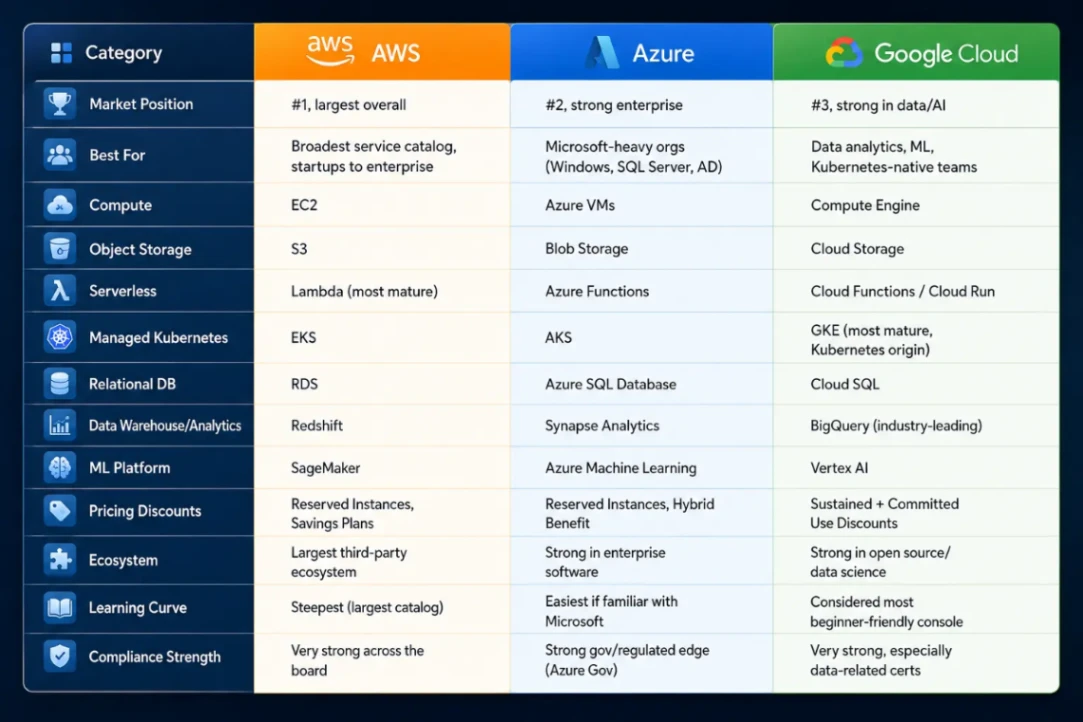
AWS, launched in 2006, remains the largest and most mature cloud provider, with the broadest overall service catalog and the largest third-party ecosystem. Microsoft Azure, launched in 2010, has built a dominant position among enterprises already invested in Microsoft's software stack, thanks to deep integration with products like Windows Server, SQL Server, and Active Directory. Google Cloud Platform, GCP, has carved out a strong niche in data analytics, machine learning, and Kubernetes, given that Kubernetes itself originated inside Google.
None of the three platforms is universally "best." Each was built with different strengths, and the right choice depends heavily on your existing technology stack, your team's expertise, and what your workloads actually require.
Market Share in 2026
AWS continues to hold the largest share of the global cloud infrastructure market, followed by Microsoft Azure in second place, with Google Cloud Platform in third. That said, the gap between the three has narrowed over the past several years, and all three continue to grow at healthy rates as overall cloud adoption keeps expanding across industries. Market share alone shouldn't drive your decision, since a smaller share doesn't mean a weaker platform, it often simply reflects different customer bases and go-to-market strategies.
Compute Services Compared
All three providers offer virtual machine services as their core compute offering: AWS with EC2, Azure with Azure Virtual Machines, and Google Cloud with Compute Engine. Functionally, these services are very similar, letting you rent virtual servers with configurable processing power, memory, and storage.
Where they start to differ is in serverless and container tooling. AWS Lambda was the first major serverless offering and remains the most mature, with the broadest set of integrations. Azure Functions offers comparable functionality with particularly smooth integration into the broader Microsoft ecosystem. Google Cloud Functions and Cloud Run are both strong options, with Cloud Run in particular standing out for how easily it runs containerized applications without managing infrastructure directly.
For container orchestration, all three offer managed Kubernetes, EKS on AWS, AKS on Azure, and GKE on Google Cloud. GKE is generally considered the most mature and polished of the three, unsurprising given Kubernetes originated at Google, though EKS and AKS have both closed much of that gap in recent years.
Storage Services Compared
AWS S3, Azure Blob Storage, and Google Cloud Storage all provide highly durable, scalable object storage, and functionally they solve the same core problem in very similar ways. Differences tend to show up more in pricing structure, regional availability, and how tightly each service integrates with other services on its own platform, rather than in raw capability.
Database Services Compared
All three platforms offer managed relational databases, AWS RDS, Azure SQL Database, and Google Cloud SQL, along with NoSQL options like AWS DynamoDB, Azure Cosmos DB, and Google Cloud Firestore or Bigtable. Azure SQL Database stands out specifically for organizations already running Microsoft SQL Server on-premises, since migration paths are particularly smooth. AWS offers the broadest overall range of purpose-built database services, covering nearly every data model imaginable. Google Cloud's Cloud Spanner, a globally distributed relational database, remains a fairly unique offering not directly matched by an equivalent on the other two platforms.
Data Analytics and AI Compared
This is one of the areas where the three platforms diverge most clearly. Google Cloud's BigQuery is widely regarded as one of the strongest fully managed data warehouse solutions on the market, and Google's broader AI and machine learning tooling through Vertex AI benefits from Google's deep research investment in the space. AWS offers a comparably broad set of analytics and machine learning services, including Redshift for data warehousing and SageMaker for machine learning, with the advantage of tighter integration across AWS's much larger overall service catalog. Azure's equivalent offerings, including Synapse Analytics and Azure Machine Learning, are strong as well, particularly for organizations already using Microsoft's Power BI and broader data ecosystem.
Pricing Comparison
All three providers use pay-as-you-go pricing models, billing based on actual usage rather than fixed rates, and all three offer some form of discount for committed or sustained usage. AWS uses Reserved Instances and Savings Plans for discounted compute pricing. Azure offers Reserved Instances and Azure Hybrid Benefit, which provides real savings for organizations with existing Microsoft licensing. Google Cloud is somewhat unique in automatically applying sustained use discounts without requiring any upfront commitment, alongside committed use discounts for further savings.
Direct price comparisons across providers are notoriously difficult because pricing structures, instance types, and discount programs don't map cleanly onto each other. In practice, most organizations find that costs end up broadly comparable across the three platforms for similar workloads, and the deciding factor tends to be existing licensing agreements, committed spend discounts, or specific service needs rather than a fundamental across-the-board price advantage for any one provider.
Security and Compliance Compared
All three platforms follow the same shared responsibility model, where the provider secures the underlying infrastructure and the customer is responsible for securing how they configure and use it. All three also maintain extensive compliance certifications covering standards like SOC 2, ISO 27001, HIPAA, and FedRAMP, making them all viable options for regulated industries.
Azure has a particular edge for organizations with strict government or highly regulated compliance needs in certain regions, given Microsoft's long history serving enterprise and government customers alongside offerings like Azure Government. AWS and Google Cloud both maintain comparably strong compliance postures, and for most organizations outside of highly specialized regulatory environments, all three are considered enterprise-ready from a security and compliance standpoint.
Ecosystem and Third-Party Integration
AWS has the largest and most mature third-party ecosystem, reflecting its position as the longest-standing major cloud provider, with the broadest range of marketplace tools, partner integrations, and community resources. Azure's ecosystem is particularly strong specifically around Microsoft's own products and a large base of enterprise software vendors already building for Windows environments. Google Cloud's ecosystem, while smaller overall, is notably strong in the open source and data science communities, given Google's own contributions to projects like Kubernetes and TensorFlow.
Ease of Use and Learning Curve
Many beginners find Google Cloud's console and service catalog somewhat more approachable to start with, partly because GCP offers a more curated set of core services compared to AWS's much larger catalog. AWS's sheer breadth of services can feel overwhelming to newcomers, though this same breadth is exactly what gives it flexibility for advanced, highly specific use cases. Azure tends to feel most intuitive to teams already familiar with Microsoft tools and terminology, given how closely its concepts and interface mirror the broader Microsoft ecosystem.
Which Platform Fits Which Situation
AWS tends to be the strongest choice for teams wanting the broadest possible service catalog, the largest talent pool of experienced engineers to hire from, and the most mature third-party ecosystem, particularly for startups and companies without strong existing ties to Microsoft or Google's ecosystems.
Azure tends to be the strongest choice for enterprises already running significant Microsoft infrastructure, including Windows Server, SQL Server, and Active Directory, where migration paths and licensing benefits make it a natural extension of existing systems.
Google Cloud tends to be the strongest choice for organizations with data-heavy workloads, machine learning ambitions, or a strong preference for open source and Kubernetes-native architectures, given Google's particular strength in these specific areas.
Can You Use More Than One Cloud Provider
Yes, and increasingly, many organizations do. A multi-cloud strategy, using more than one provider for different workloads or as a deliberate redundancy measure, has become increasingly common, particularly among larger enterprises. Tools like Terraform make managing infrastructure across multiple cloud providers considerably more practical than it used to be, since teams can use a single, consistent workflow regardless of which underlying platform they're deploying to. That said, multi-cloud strategies do add real operational complexity, and many smaller teams find it more practical to standardize on a single provider until there's a clear, specific reason not to.
Frequently Asked Questions
Which cloud provider is the cheapest in 2026?
There is no single cheapest provider across the board, since pricing depends heavily on specific services used, committed usage discounts, and existing licensing arrangements. Costs tend to be broadly comparable across AWS, Azure, and Google Cloud for similar workloads.
Which cloud provider is best for beginners?
Google Cloud is often considered slightly more approachable for beginners due to its more curated service catalog, though AWS has the largest amount of learning resources and community support available given its position as the most widely used platform.
Is Azure better than AWS for enterprises?
Azure often has an advantage for enterprises already heavily invested in Microsoft products like Windows Server, SQL Server, and Active Directory, due to smoother migration paths and licensing benefits, though AWS remains a strong enterprise option as well.
Which cloud platform is best for machine learning?
Google Cloud is often regarded as particularly strong for machine learning and data analytics workloads, largely due to BigQuery and Vertex AI, though AWS SageMaker and Azure Machine Learning are both mature, capable alternatives.
Do I need to choose only one cloud provider?
No, many organizations use a multi-cloud strategy, running different workloads on different providers, though this does add operational complexity. Smaller teams often benefit from standardizing on a single provider unless there's a specific reason to do otherwise.