

Infrastructure management has changed significantly over the past ten years, and Terraform has been a major part of that change. By setting up cloud resources manually, companies now use Infrastructure as Code to set up, manage, and grow infrastructure in an efficient way. Whether you're setting up machines on AWS, setting up Kubernetes clusters on Azure, or managing network resources across many cloud providers, Terraform makes it easier through automation and consistency.
In recent years, the Infrastructure as Code field has seen a big change. After HashiCorp changed the way Terraform is licensed, OpenTofu came into being as a community-led open-source alternative to Terraform. Both tools have a base and support similar ways of working, but they are different when it comes to how they are managed, how they are licensed, and where they are going in the future. This has made many DevOps teams ask a question: Should they keep using Terraform or move to OpenTofu?
In this article we will look at Terraform and OpenTofu by checking their features the support from the community, how they charge for their services and situations where they are used in life. This will help you choose which Infrastructure as Code tool is right for your work in 2026. If you are a DevOps engineer, someone who works with the cloud, or getting ready for a DevOps certification, this comparison will give you the information you need. It will show you what each tool can do and what might not be as good so you can make choices about your infrastructure.
What Is Terraform?
Terraform is a tool that helps people who make software and the people who make sure the software works properly. It is made by a company called HashiCorp. This tool is really good at helping people set up the systems that the software needs to run on.
By having to manually set up all of these systems, people can use Terraform to write some code that does it for them. Terraform uses something called HashiCorp Configuration Language, or HCL for short, to understand what the code is saying.
One of the things about Terraform is that it works with many different cloud services. Unlike tools that are only for one cloud, Terraform can handle resources on Amazon Web Services (AWS), Microsoft Azure, Google Cloud Platform (GCP), Kubernetes, VMware, Oracle Cloud, and many other platforms using provider plugins. This makes it a good choice for companies that use more than one cloud.
Terraform uses a process that has four main steps:
- Write infrastructure setups in HCL.
- Plan the changes before putting them into action.
- Apply the changes to create or change infrastructure.
- Keep track of changes over time. Make sure the setup is as it should be.
A key thing that makes Terraform different is the state file, which keeps track of what the infrastructure looks like. By comparing what is needed with what's already there, Terraform finds the exact changes that are needed which avoids unnecessary changes and lowers the risk of deployment.
Main Features of Terraform
- Infrastructure as Code using HCL
- Support for clouds and hybrid cloud setups
- Big community of providers
- Reusable parts for standard setups
- Plans made before changes to infrastructure
- Tracking of resources using state files
- Integration with continuous integration and continuous delivery pipelines
- Big open-source community and lots of documentation
Common Uses
Terraform is often used for:
- Setting up cloud infrastructure
- Putting up Kubernetes clusters
- Setting up virtual networks and security groups
- Managing databases and storage
- Building setups that can be repeated for DevOps
- Automating backup and recovery setups
- Scaling infrastructure across cloud providers
Because of its flexibility, ability to automate, and big community, Terraform has become one of the most wanted skills for DevOps engineers, cloud architects, and platform engineering teams.
What Is OpenTofu?
OpenTofu is an open-source Infrastructure as Code tool that was created as a community-led version of Terraform after HashiCorp changed Terraform's license from the Mozilla Public License (MPL 2.0) to the Business Source License (BUSL). This project is managed by the Linux Foundation. It is designed to offer a way to use Infrastructure as Code without worrying about being limited by commercial licenses.
One of the goals of OpenTofu is to make sure that companies can use Infrastructure as Code without being worried about proprietary licenses. Since it came from Terraform, OpenTofu keeps the HCL language, supports most of the existing Terraform modules and providers, and uses almost the same commands for planning and setting up infrastructure.
For teams using Terraform, moving to OpenTofu is usually not very hard, allowing them to keep their existing setups while using an open-source solution.
Main Features of OpenTofu
- Open-source under the MPL 2.0 license
- Controlled by the community through the Linux Foundation
- Very similar to Terraform in configuration
- Support for existing Terraform providers and modules
- Ability to set up infrastructure across many clouds
- Tracking of resources and making plans before changes
- Active contributions from the community and a clear plan for the future
Even though OpenTofu is a newer project compared to Terraform, it has become more and more popular among companies and developers who care about open-source control and long-term options. Its focus on keeping things similar while encouraging community-driven improvements makes it an interesting choice for DevOps teams.
Terraform versus OpenTofu: Key Differences
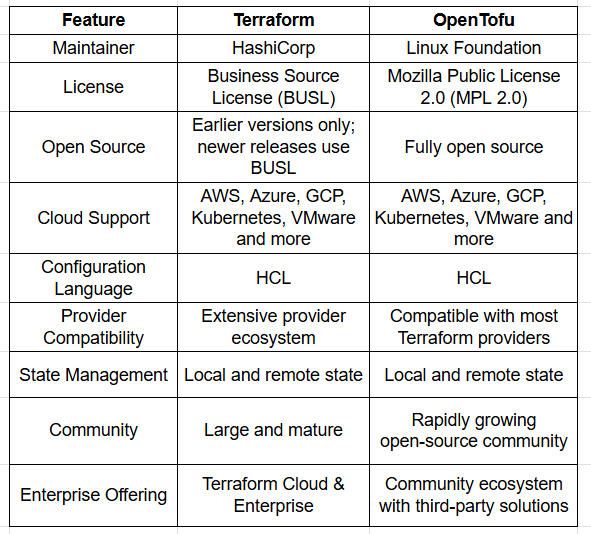
At first, Terraform and OpenTofu looked almost the same. Both use HashiCorp Configuration Language (HCL), follow the ideas of Infrastructure as Code, and support many cloud providers. However, the biggest differences are in how they're licensed, how they are run, and how they will grow in the future. Understanding these differences will help you pick the tool for your infrastructure needs.
Licensing
The biggest difference between Terraform and OpenTofu is how they are licensed. Terraform's newer versions are given out under the Business Source License (BUSL). People and companies can still use Terraform. The license puts limits on certain ways it can be used, especially for companies creating similar services. OpenTofu is given out under the Mozilla Public License (MPL 2.0), which makes it an open-source project. Companies that want to use open-source software often see this as a plus because the future of the project is decided by the community and not by one company.
Governance
Terraform is. Kept by HashiCorp, which means the company decides what the product will do next, what licenses it will use, and when new features come out. OpenTofu works differently. It is managed by the Linux Foundation, where the way it is built and what it does next is decided by people who give their time and ideas. This way of managing things reduces worries about being stuck with one company. Encourages more people to work together from cloud companies, big businesses, and open-source people.
Multi-Cloud Support
Both Terraform and OpenTofu are very good at handling infrastructure across clouds. Whether you are putting resources on AWS, Microsoft Azure, Google Cloud Platform, Kubernetes, or VMware, both tools let you manage your infrastructure using one language. For companies that are using more than one cloud, there is not much difference in how they work regularly.
Provider and Module Compatibility
One of the points of OpenTofu is how well it works with existing Terraform setups. Most Terraform providers, modules, and setups can be used with OpenTofu with few or no changes. This makes it easier to move over for teams that want to use OpenTofu without having to change their setups. Terraform, on the other hand, still has one of the biggest sets of providers in the Infrastructure as Code world with support for hundreds of cloud services, SaaS apps, databases, network services, and Kubernetes resources.
Community and Ecosystem
Terraform has been the way to use Infrastructure as Code for many years. Because of this, it has:
- Lots of guides
- Thousands of parts that can be reused
- A group of people who work on it
- Widespread use by big companies
- A lot of tools and training
OpenTofu is newer but has grown very fast. Since it started, many people and companies have added to its development, guides, and tools. Even though its collection of tools is still growing it can use a lot of what's available for Terraform.
Enterprise Features
For companies that need more features for working together, controlling things, and setting rules, Terraform offers Terraform Cloud and Terraform Enterprise. These tools have features like:
- Managing state that's not on the local computer
- Working with a team
- Rules that are set in code
- Private places to store modules
- Estimating costs
- Controlling how things are set up
OpenTofu is focused on giving a strong open-source way to manage infrastructure. Companies that need features usually use other tools for things like storing state that is not on the local computer, pipelines for testing and putting things into use, keeping security details safe, and making sure rules are followed.
Similarities Between Terraform and OpenTofu
Even though they are different, Terraform and OpenTofu share the main idea of using code for infrastructure. For DevOps teams, the everyday work is almost the same no matter which tool they use.
Both tools offer:
- Setting up infrastructure using code
- HCL (HashiCorp Configuration Language)
- Setting up infrastructure in a way
- Using many different clouds
- Parts that can be used again
- Plans made before changes to infrastructure
- Tracking of resources using state files
- Support for storing state remotely
- Integration with workflows that use Git
- Compatibility with pipelines for testing and putting things into use
- Keeping track of versions of infrastructure
- Automating across clouds
For people who already know Terraform, moving to OpenTofu usually means just a small amount of learning because the commands, the way things are written and the way projects are set up are very similar.
When Should You Choose Terraform?
Deciding between Terraform and OpenTofu is more about what your company needs than what the tools can do. Even though both tools have ways of working now, Terraform is still the first choice for many big companies because of its well-developed community, support from the company, and the many companies that use it.
Choose Terraform if:
- Your company already uses products from HashiCorp like Vault, Nomad or Consul.
- You need features for companies like Terraform Cloud or Terraform Enterprise.
- Your team uses a set of providers with lots of guides.
- You want to have access to training, certificates, and help from the company.
- You are working with important cloud infrastructure.
Terraform is especially good for companies that want a proven way to manage infrastructure that has been used by many people and keeps getting better.
When Should You Choose OpenTofu?
OpenTofu is a choice for companies that like open-source software and want to have control over how things are managed. It works well with Terraform so teams can keep using the ways they always have while also getting all the benefits of an open-source project.
Pick OpenTofu if:
- You want a tool that's completely open-source for Infrastructure as Code.
- Your company wants to stay away from rules that come with the latest Terraform versions.
- You care a lot about how the project's managed by the community.
- You want to switch from Terraform without making changes to your current setup.
- Your system mainly uses Terraform tools and parts.
As OpenTofu keeps getting better, it is likely to be a more popular choice for companies that like open-source ideas.
Pros and Cons
Terraform
Pros
- Top Infrastructure as Code tool in the industry
- Collection of tools to use with it
- Good support for different cloud systems
- Well-documented with lots of guides
- Big group of people using it and lots of companies rely on it
- Works well with build and release systems
- Official support through Terraform Cloud
Cons
- Newer versions use a special license that limits some uses
- Some better teamwork features need money
- The plan for future features is decided by one company
OpenTofu
Pros
- Completely open-source under a specific license
- Governed by the community under a major organization
- Works with most Terraform setups
- Easy to move from Terraform
- Development is open and clear
Cons
- Smaller group of people using it compared to Terraform
- Not as many business tools available
- Fewer outside tools to use than Terraform
- Still growing as a tool for big companies
Frequently Asked Questions
Is Terraform better than OpenTofu?
No one tool is always better. Terraform has a setup, money support, and tools that are ready for big companies. OpenTofu focuses on being source- and community-managed by the people. The best choice depends on what your company wants in terms of how it's run and how it works.
Is Terraform still free?
Yes. Terraform has a version for people and companies. The new versions use a special license that limits some business uses.
Can OpenTofu use Terraform modules?
Yes. OpenTofu is made to work with Terraform modules and tools, so changing is easy for groups.
Can I move from Terraform to OpenTofu?
Most of the time, yes. Both tools use the same way to write code and work the same way, so most old setups can be moved with just a few changes. It's still a good idea to check your system in a place that is not used for real work before moving.
Which tool is best for people in 2026?
If you are just starting with Infrastructure as Code, Terraform is the place to begin. It has the learning help of lots of guides, and a lot of people use it. Once you know Terraform, it's easy to switch to OpenTofu because they use the same way to write code and work the same way.
Final Verdict
There is no doubt that Terraform's still the best in Infrastructure as Code in 2026. It has a lot of tools to use, is very ready for companies, has a strong group of people using it, and is supported well. It is a choice for automating systems on AWS, Azure, Google Cloud, Kubernetes, and mixed setups.
OpenTofu has also shown itself to be a choice by keeping the same way as Terraform while being completely open-source and managed by the community. For companies that like open-source rules and the chance to work with people, it gives a path.
In the end what you choose depends on what your company wants:
- Pick Terraform if you want a setup business help and many companies use it.
- Pick OpenTofu if you care about open-source rules, being able to use it, and working with people in the long run.
No matter which one you choose, learning the basics of Terraform, like Infrastructure as Code, managing state using modules, working with tools, and automating systems, will help you get skills that are needed in DevOps and cloud jobs.
Ready to master DevOps? Enroll in Paperlive Learning's DevOps Training to gain hands-on experience with Terraform, OpenTofu, Kubernetes, Docker, and more. Build job-ready skills and prepare for leading DevOps certifications.