

If you're starting your DevOps journey, you've probably come across Terraform and Docker Swarm. Since both are widely used in DevOps workflows, many beginners assume they serve the same purpose. In reality, they solve completely different problems. Whether you're pursuing a DevOps certification or enrolling in an online course, understanding the difference between these tools is essential. Terraform is an Infrastructure as Code (IaC) tool that provisions and manages infrastructure, while Docker Swarm is a container orchestration platform that deploys and manages Docker containers.
In this guide, we'll compare Terraform and Docker Swarm, explain their use cases, highlight their key differences, and help you decide which tool to learn based on your career goals.
Terraform vs Docker Swarm
Terraform and Docker Swarm are not competitors—they are complementary tools.
- Terraform automates the creation and management of infrastructure such as virtual machines, networks, databases, and cloud services.
- Docker Swarm manages and orchestrates Docker containers running on that infrastructure.
A common real-world workflow is:
Terraform → Creates Infrastructure → Docker Swarm → Deploys & Manages Containers
What is Terraform?
Terraform, developed by HashiCorp, is an open-source Infrastructure as Code tool that allows you to define cloud infrastructure using configuration files instead of manually creating resources.
With Terraform, you can provision:
- AWS EC2 instances
- Azure Virtual Machines
- Google Cloud resources
- VPCs and networking
- Kubernetes clusters
- Storage services
- IAM users and roles
Terraform uses a declarative language called HCL (HashiCorp Configuration Language). You describe the desired infrastructure, and Terraform determines the steps needed to achieve that state.
Key Features
- Infrastructure as Code
- Multi-cloud support
- Reusable modules
- State management
- Version-controlled infrastructure
- Automated provisioning
Example Use Case:
A company wants to deploy identical production environments across AWS and Azure. Terraform can provision the entire infrastructure with a single configuration.
What is Docker Swarm?
Docker Swarm is Docker's native container orchestration platform. It groups multiple Docker hosts into a single cluster, allowing applications to run across several servers while providing load balancing, scaling, and high availability.
A Docker Swarm cluster consists of:
- Manager Nodes – Manage the cluster and scheduling.
- Worker Nodes – Run application containers.
Docker Swarm automatically distributes containers across available nodes and can restart containers if one fails.
Key Features
- Native Docker integration
- Simple cluster management
- Service discovery
- Built-in load balancing
- Rolling updates
- Horizontal scaling
Example Use Case:
A startup running several microservices can use Docker Swarm to distribute containers across multiple servers with minimal configuration.
Terraform vs Docker Swarm: Key Differences
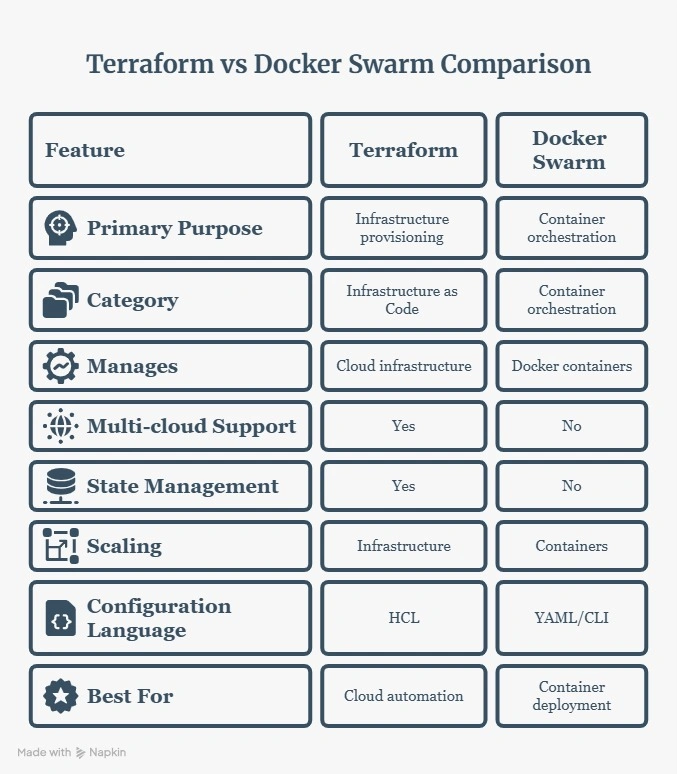
The Biggest Difference
Think of building a house:
- Terraform builds the house by creating the land, electricity, plumbing, and structure.
- Docker Swarm manages the people living inside the house, ensuring everything runs smoothly.
When Should You Use Terraform?
Terraform is ideal when your goal is to automate infrastructure creation.
Use Terraform for:
- Provisioning cloud infrastructure
- Creating Kubernetes clusters
- Building networking resources
- Managing cloud databases
- Disaster recovery environments
- Multi-cloud deployments
- Infrastructure version control
Organizations adopting DevOps often rely on Terraform to eliminate manual infrastructure configuration and ensure consistency across environments.
When Should You Use Docker Swarm?
Docker Swarm is suitable when you need to deploy and manage containerized applications.
Use Docker Swarm for:
- Running Docker containers across multiple servers
- Scaling applications
- High availability
- Load balancing
- Rolling updates
- Small to medium-sized microservice deployments
Docker Swarm is particularly useful for teams already invested in Docker and looking for a lightweight orchestration solution.
Can Terraform and Docker Swarm Work Together?
Yes. In fact, many organizations use them together.
A typical deployment workflow looks like this:
- Terraform provisions cloud servers, networking, and security groups.
- Docker is installed on those servers.
- Docker Swarm creates a cluster.
- Applications are deployed as Docker services.
- Docker Swarm manages scaling, networking, and updates.
Terraform handles the infrastructure, while Docker Swarm manages the application layer.
Which One Should You Learn?
The answer depends on your career goals.
Learn Terraform if you want to become:
- DevOps Engineer
- Cloud Engineer
- Site Reliability Engineer (SRE)
- Platform Engineer
- Infrastructure Engineer
Learn Docker Swarm if you want to:
- Understand container orchestration
- Deploy Docker applications
- Work on small containerized environments
- Learn orchestration concepts before Kubernetes
If you're aiming for a modern DevOps role, Terraform should generally be your first choice because Infrastructure as Code has become a core DevOps skill. Docker Swarm is still valuable for learning container orchestration, although many enterprises now use Kubernetes for large-scale deployments.
Frequently Asked Questions
Is Terraform better than Docker Swarm?
Neither is better because they solve different problems. Terraform provides infrastructure, while Docker Swarm manages containers.
Can Terraform replace Docker Swarm?
No. Terraform does not provide container orchestration capabilities.
Can Docker Swarm create cloud infrastructure?
No. Docker Swarm only manages Docker containers and services.
Is Docker Swarm still relevant?
Yes. While Kubernetes dominates large enterprise environments, Docker Swarm remains a good choice for smaller deployments due to its simplicity.
Should beginners learn Terraform first?
Yes. Learning Terraform first builds a strong foundation in cloud automation and Infrastructure as Code before moving into container orchestration.
Conclusion
Terraform and Docker Swarm are designed for different stages of the DevOps lifecycle. Terraform focuses on automating infrastructure provisioning, while Docker Swarm focuses on deploying and managing containerized applications.
Instead of choosing one over the other, understand how they complement each other. Terraform prepares the infrastructure, and Docker Swarm ensures applications run efficiently on that infrastructure. If you're beginning your DevOps journey, start with Terraform to build a solid understanding of cloud automation. Then explore Docker Swarm to learn container orchestration concepts before progressing to more advanced orchestration platforms.