

Infrastructure as Code (IaC) has transformed the way organizations provision and manage cloud infrastructure. As cloud-native adoption continues to grow in 2026, two tools frequently appear in DevOps discussions: Terraform and Crossplane. While both automate infrastructure management, they follow different approaches and are designed for different use cases.
If you're pursuing a DevOps certification or enrolling in a DevOps course online, understanding the differences between Terraform and Crossplane will help you choose the right tool for your projects and career. In this guide, we'll compare both platforms based on architecture, workflow, scalability, Kubernetes integration, use cases, and industry adoption.
Terraform vs Crossplane
If you're looking for the short answer:
- Choose Terraform if you need a mature, cloud-agnostic Infrastructure as Code solution for provisioning infrastructure across multiple cloud providers.
- Choose Crossplane if you're building Kubernetes-native platforms and want to manage infrastructure using Kubernetes APIs and GitOps workflows.
In many modern organizations, Terraform provides infrastructure while Crossplane manages cloud resources within Kubernetes environments.
What is Terraform?
Terraform, developed by HashiCorp, is one of the most widely adopted Infrastructure as Code tools. It enables teams to define infrastructure using declarative configuration files written in HashiCorp Configuration Language (HCL).
Terraform supports hundreds of providers, allowing organizations to provision and manage resources across AWS, Azure, Google Cloud, Kubernetes, VMware, GitHub, and many other platforms.
Key Features
- Infrastructure as Code (IaC)
- Multi-cloud provisioning
- Reusable modules
- State management
- Large provider ecosystem
- Infrastructure automation
Best Use Cases
- Cloud infrastructure provisioning
- Multi-cloud deployments
- Network automation
- Kubernetes cluster creation
- Disaster recovery environments
What is Crossplane?
Crossplane is an open-source cloud control plane that extends Kubernetes to manage cloud infrastructure. Instead of using separate infrastructure tools, Crossplane allows developers to provision cloud resources through Kubernetes Custom Resource Definitions (CRDs).
Everything is managed using Kubernetes manifests, making Crossplane an ideal choice for organizations adopting GitOps and Internal Developer Platforms (IDPs).
Key Features
- Kubernetes-native infrastructure management
- Custom Resource Definitions (CRDs)
- GitOps integration
- Self-service infrastructure
- Infrastructure abstraction
- Composition and reusable templates
Best Use Cases
- Platform engineering
- Internal Developer Platforms
- GitOps workflows
- Kubernetes-centric organizations
- Self-service infrastructure
Terraform vs Crossplane: Feature Comparison
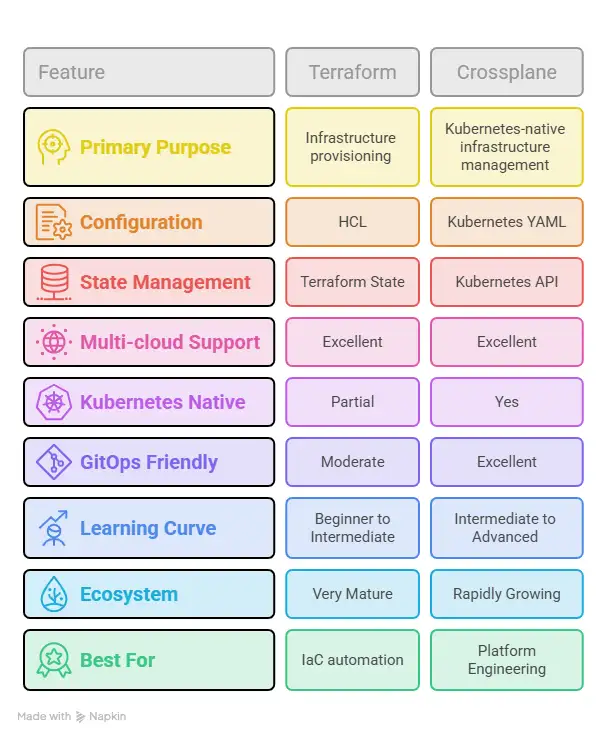
Key Differences Between Terraform and Crossplane
1. Infrastructure Management Approach
Terraform provides infrastructure directly using cloud provider APIs. You write HCL code, execute Terraform commands, and Terraform creates or updates the infrastructure.
Crossplane, on the other hand, extends Kubernetes. Infrastructure becomes another Kubernetes resource that is continuously reconciled to match the desired state.
2. State Management
Terraform maintains a dedicated state file that tracks infrastructure resources. This state file must be secured and managed carefully.
Crossplane doesn't require a separate state file. Instead, it relies on Kubernetes' reconciliation loop and stores resource state within the Kubernetes control plane.
3. Multi-Cloud Support
Both tools support AWS, Azure, Google Cloud Platform, and other providers.
Terraform has the advantage of a larger provider ecosystem developed over many years.
Crossplane continues to expand its provider ecosystem rapidly, particularly for cloud-native environments.
4. GitOps Integration
GitOps has become a preferred deployment model in modern DevOps.
Crossplane integrates naturally with GitOps tools such as Argo CD and Flux because infrastructure definitions are standard Kubernetes manifests.
Terraform can also participate in GitOps workflows but often requires additional tooling and automation.
5. Learning Curve
Terraform is generally easier to learn. Its HCL syntax is straightforward, and extensive documentation makes it beginner-friendly.
Crossplane requires familiarity with Kubernetes concepts such as CRDs, controllers, reconciliation, and YAML configurations.
When Should You Choose Terraform?
Terraform is the right choice if you:
- Manage infrastructure across multiple cloud providers
- Need a mature and stable IaC tool
- Want extensive provider support
- Build enterprise cloud environments
- Are new to Infrastructure as Code
Terraform remains the industry standard for infrastructure provisioning in 2026 and is widely used across enterprises.
When Should You Choose Crossplane?
Crossplane is an excellent choice if you:
- Build Internal Developer Platforms (IDPs)
- Use Kubernetes extensively
- Follow GitOps practices
- Want self-service infrastructure
- Need platform engineering capabilities
Organizations adopting cloud-native architectures increasingly choose Crossplane to simplify infrastructure management within Kubernetes.
Can Terraform and Crossplane Work Together?
Yes. Many organizations combine the strengths of both tools.
A common workflow looks like this:
- Terraform provisions foundational infrastructure such as VPCs, Kubernetes clusters, IAM roles, and networking.
- Crossplane runs inside the Kubernetes cluster.
- Developers request cloud resources using Kubernetes manifests.
- Crossplane provisions and manages those resources automatically.
This hybrid approach offers the flexibility of Terraform with the self-service capabilities of Crossplane.
Terraform vs Crossplane: Which One Should You Learn?
Your choice depends on your career path.
Learn Terraform if you want to become:
- DevOps Engineer
- Cloud Engineer
- Infrastructure Engineer
- Solutions Architect
- Site Reliability Engineer (SRE)
Learn Crossplane if you want to become:
- Platform Engineer
- Kubernetes Administrator
- Cloud Platform Engineer
- Internal Developer Platform Engineer
If you're starting your DevOps journey, Terraform should be your first Infrastructure as Code tool because of its simplicity, broad adoption, and strong job demand. Once you're comfortable with Kubernetes, learning Crossplane will prepare you for next-generation platform engineering roles.
Frequently Asked Questions
Is Crossplane replacing Terraform?
No. Crossplane complements rather than replaces Terraform. Many organizations use Terraform for infrastructure provisioning and Crossplane for Kubernetes-native infrastructure management.
Which tool is easier to learn?
Terraform is easier for beginners because it has a simpler syntax, extensive documentation, and a lower learning curve.
Does Crossplane support AWS and Azure?
Yes. Crossplane supports AWS, Microsoft Azure, Google Cloud Platform, and several other cloud providers through provider packages.
Which tool is better for Kubernetes?
Crossplane is designed specifically for Kubernetes and offers a more seamless experience for managing cloud infrastructure within Kubernetes clusters.
Should beginners learn Terraform or Crossplane first?
Beginners should start with Terraform to build a solid understanding of Infrastructure as Code. After gaining Kubernetes experience, learning Crossplane becomes much easier.
Conclusion
Terraform and Crossplane represent two different approaches to infrastructure automation. Terraform remains the preferred choice for traditional Infrastructure as Code, offering unmatched provider support, simplicity, and enterprise adoption. Crossplane, meanwhile, is shaping the future of cloud-native infrastructure management by extending Kubernetes into a universal control plane.
Rather than viewing them as competing tools, it's better to see them as complementary technologies. Terraform excels at provisioning infrastructure, while Crossplane empowers platform teams to deliver self-service infrastructure through Kubernetes.
For most DevOps professionals in 2026, learning Terraform first is the smartest investment. As your expertise grows in Kubernetes and platform engineering, adding Crossplane to your skill set will position you for the next generation of cloud-native infrastructure management.